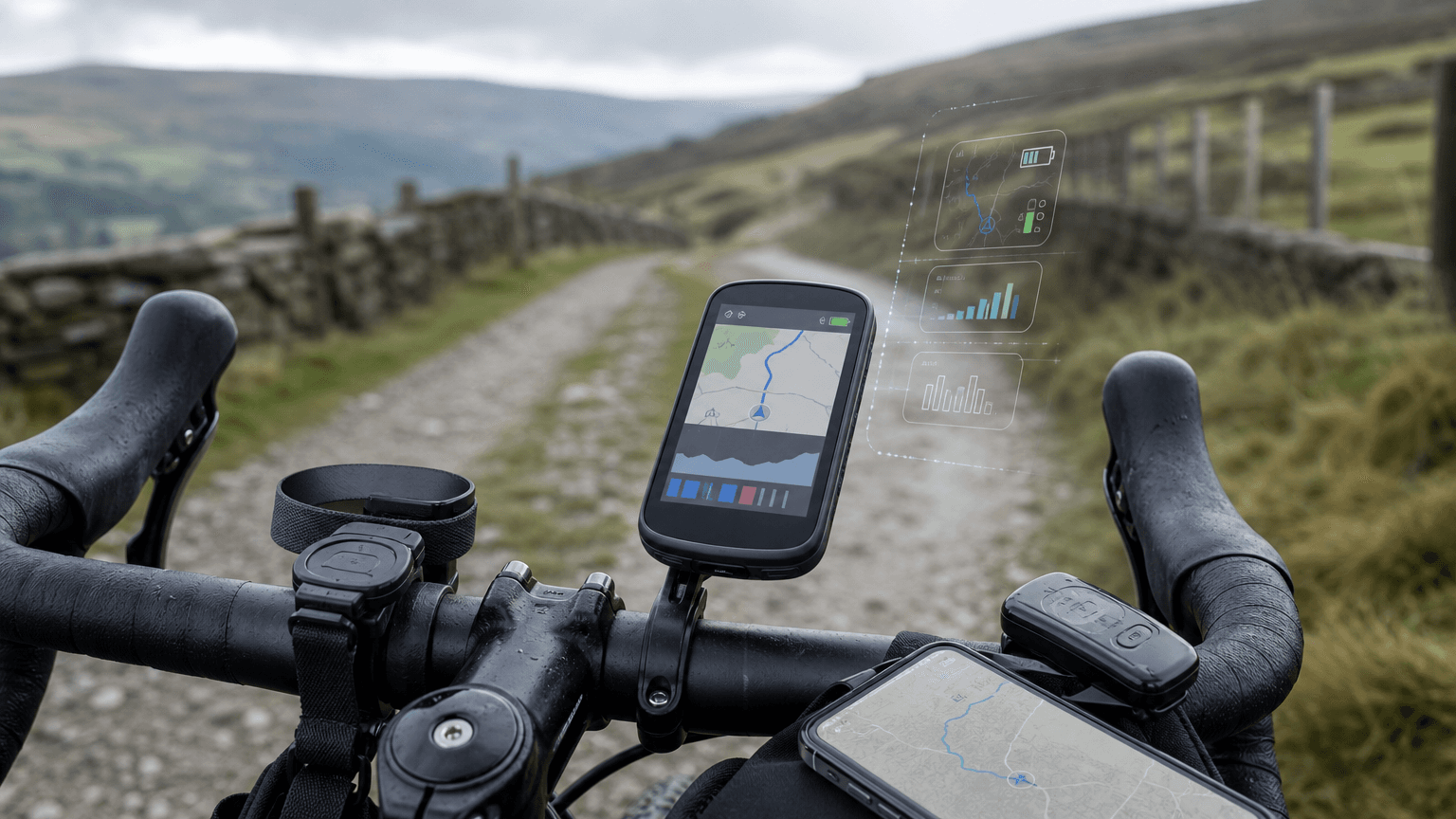
Picking the right GPS cycling computer isn't a matter of buying the most expensive device on the shelf. The best computer for your rides is the one that matches your ride distance, your navigation habits, and the sensors you already own, ideally bought at a price that leaves something in the budget for the next upgrade.
This guide is for value-conscious UK road and gravel riders who want to make a confident, well-informed purchase in 2026. Whether you're doing 60-mile sportives on familiar roads or multi-day bikepacking routes with patchy mobile signal, every recommendation below is backed by manufacturer-rated battery figures and practical buying logic.
Quick chooser: which computer should you buy?
Before diving into the details, use this decision tree to narrow down your choice:
- Mostly road, rides under 4 hours: Wahoo ELEMNT BOLT v2 or Garmin Edge 540. Compact form, clean display, no battery anxiety.
- Gravel with regular navigation: Hammerhead Karoo 3 or Wahoo ELEMNT ROAM v2. Touchscreen mapping and strong rerouting capability.
- All-day endurance (8-12 hours): Bryton Rider 750 or Garmin Edge 840 Solar. Both offer serious battery reserves without constant charging.
- Long bikepacking / weak signal: Bryton Rider 750 SE. A manufacturer-rated 40 hours on a single charge is in a class of its own for off-grid use.
- Best value when on sale: Bryton at any tier, or a previous-generation Garmin Edge (840/540) when discounted by 20%+. See the value section below.
What matters most (and what to ignore)
GPS accuracy and GNSS
Multi-band GNSS is the current standard worth paying for. It combines signals from multiple satellite constellations simultaneously, which improves positional accuracy in tree cover, urban canyons, and valleys, all common on UK riding. The Garmin Edge 840 Solar includes multi-band GNSS technology as a stated product feature. Wahoo and Hammerhead have also adopted multi-band positioning in their current-generation devices.
Single-frequency GPS units still work fine for straightforward road riding. If you're mainly following well-surfaced lanes and don't need sub-metre accuracy, you won't notice the difference in day-to-day use. Where multi-band earns its keep is on rooty gravel trails or technical descents where you're actually following a mapped line closely.
Battery life
Manufacturer-rated battery figures are always best-case: screen at minimum brightness, no connected sensors, no active routing. Real-world usage on a UK winter day, screen brighter than default, ANT+ sensors active, routing enabled, Bluetooth live tracking on, can cut quoted figures by 30-40%. Use the manufacturer numbers as a ceiling, not an expectation.
That said, the spread between devices is real and significant. More on specific figures in the battery deep-dive below.
Screen readability in rain
This matters more than spec sheets suggest. A transflective colour display (Garmin Edge series, Wahoo ELEMNT) performs well in direct sunlight without needing maximum brightness. Touchscreen devices like the Hammerhead Karoo 3 have a larger, higher-resolution screen that reads well in most conditions, though touchscreens can be glove-unfriendly in cold or wet conditions. Wahoo's button-based interface is a genuine advantage on a wet October ride in the Peaks.
Sensors
Any current flagship computer supports both ANT+ and Bluetooth. If you use a power meter with ANT+ FEC (typically Shimano Di2 or older power meters), confirm your device supports it. Budget devices sometimes drop ANT+ entirely, which locks you out of most established sensors. Check before you buy.
Smartphone pairing
Pairing should mean: upload a route from Komoot or your preferred platform, send it to the device via the companion app in seconds, ride the route, and have the file auto-sync to Strava/TrainingPeaks when you get home. If any part of that workflow regularly fails, the device is costing you time on every ride. App reliability is where Garmin and Wahoo have a clear track record; the Hammerhead Climber app is newer but has matured significantly.
Top picks for UK road and gravel
Garmin Edge 840 Solar: best for all-day road and gravel
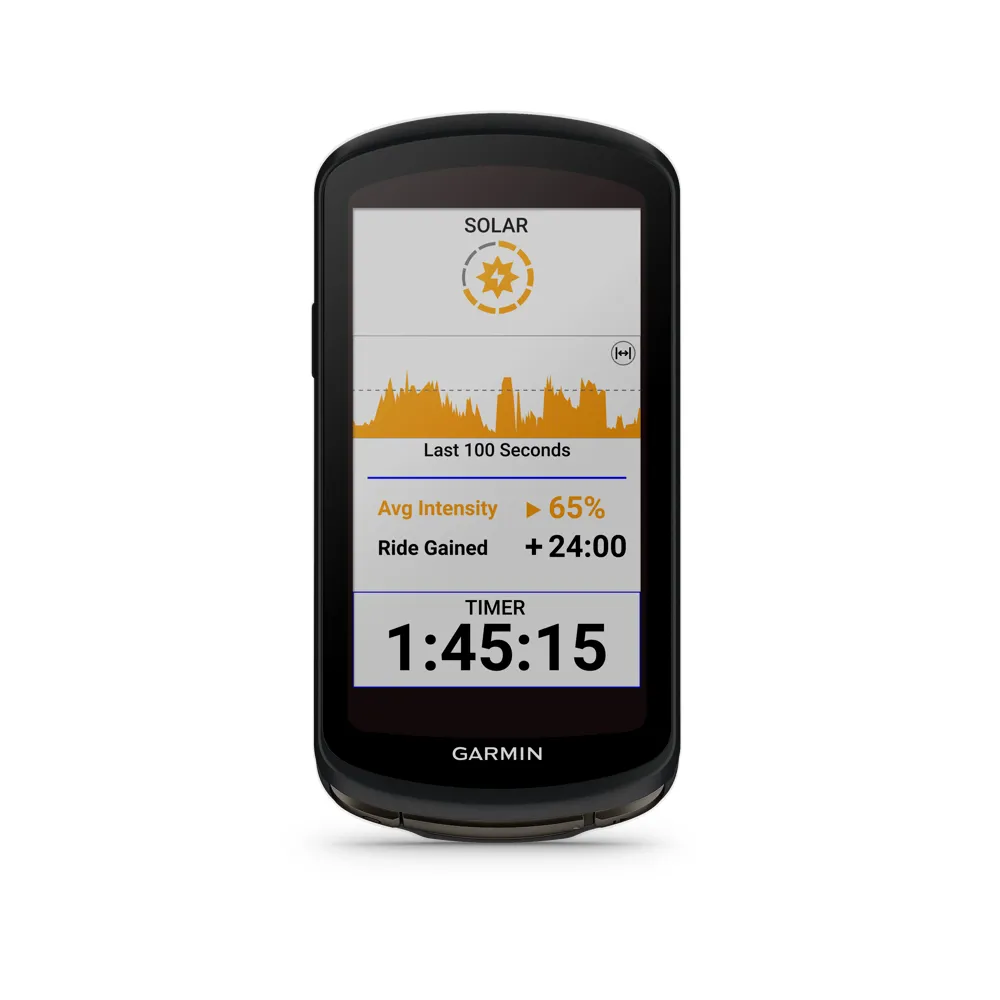
Garmin's Edge 840 Solar is one of the most capable all-round computers available. According to Garmin's own product listing, it offers up to 32 hours in intense mode and up to 60 hours in battery saver mode, with multi-band GNSS for positioning accuracy. Navigation is mature and reliable: ClimbPro gives live gradient profiles, and turn-by-turn routing via loaded GPX or Garmin Connect is well-established.
The Garmin ecosystem is the deepest in cycling: Connect IQ apps, compatibility with the full Garmin sensor range, and solid third-party support including Komoot, Strava, Wahoo SYSTM, and TrainingPeaks. The solar panel adds marginal charge on long summer rides but doesn't meaningfully replace battery management on most UK cloud days.
Value check: at full RRP (typically £499-£549), it's harder to justify over the Edge 540. At 20-25% off, it represents excellent value. Monitor the GPS computers deals page on Cycling Deals UK for periodic price drops at UK retailers including Sigma Sports.
Wahoo ELEMNT ROAM v2: best for mapping usability
According to Wahoo's support documentation, the ROAM v2 has a manufacturer-rated battery life of 17 hours, solid for long rides. The ELEMNT BOLT v2 is rated at 15 hours and the original ELEMNT at 16 hours.
Where Wahoo earns consistent praise is in the simplicity of its setup and route workflow. The ELEMNT companion app handles everything from screen layout to route transfer cleanly, and Komoot integration is tighter here than on most competitors. The ROAM v2 features a colour display, turn-by-turn navigation, and multiband GPS. For riders who want good navigation without wrestling with a complex menu system, it's the easiest device to live with day to day.
The button-only interface is a practical advantage in cold or wet conditions, and the unit's physical durability is well-regarded. Wahoo's Connect IQ equivalent is less extensive than Garmin's, but most riders won't hit its limits.
Value check: the ROAM v2 sits around £349-£399 at full price. At 15-20% off it becomes one of the best road computers in the £280-£340 range. Check Wahoo deals for current UK pricing.
Hammerhead Karoo 3: best for touchscreen mapping and gravel navigation
The Karoo 3 runs a full Android-based operating system on a large colour touchscreen, which gives it the most map-rich interface of any cycling computer in this tier. Surface type overlays, offline map data, and rerouting are all strong. For riders tackling mixed-surface routes where map context matters, no current device beats it for at-a-glance clarity.
Battery figures for the Karoo 3 haven't been separately cited here; the Karoo 2, per Hammerhead's own support documentation (updated 8 September 2023), offers "between 7 and 14+ hours of battery life depending on the features employed during usage." The Karoo 3 improves on this with a larger battery, though exact manufacturer figures should be confirmed on Hammerhead's current product pages. If you're doing rides beyond 8 hours, bring a small USB-C power bank.
The touchscreen is excellent in dry conditions; in heavy rain or with thick gloves, physical buttons are faster. Garmin and Wahoo have an edge there.
Value check: the Karoo 3 launches at a premium price point. It becomes particularly compelling when discounted by 15%+ against full RRP.
Bryton Rider 750 SE: best for maximum battery life and value
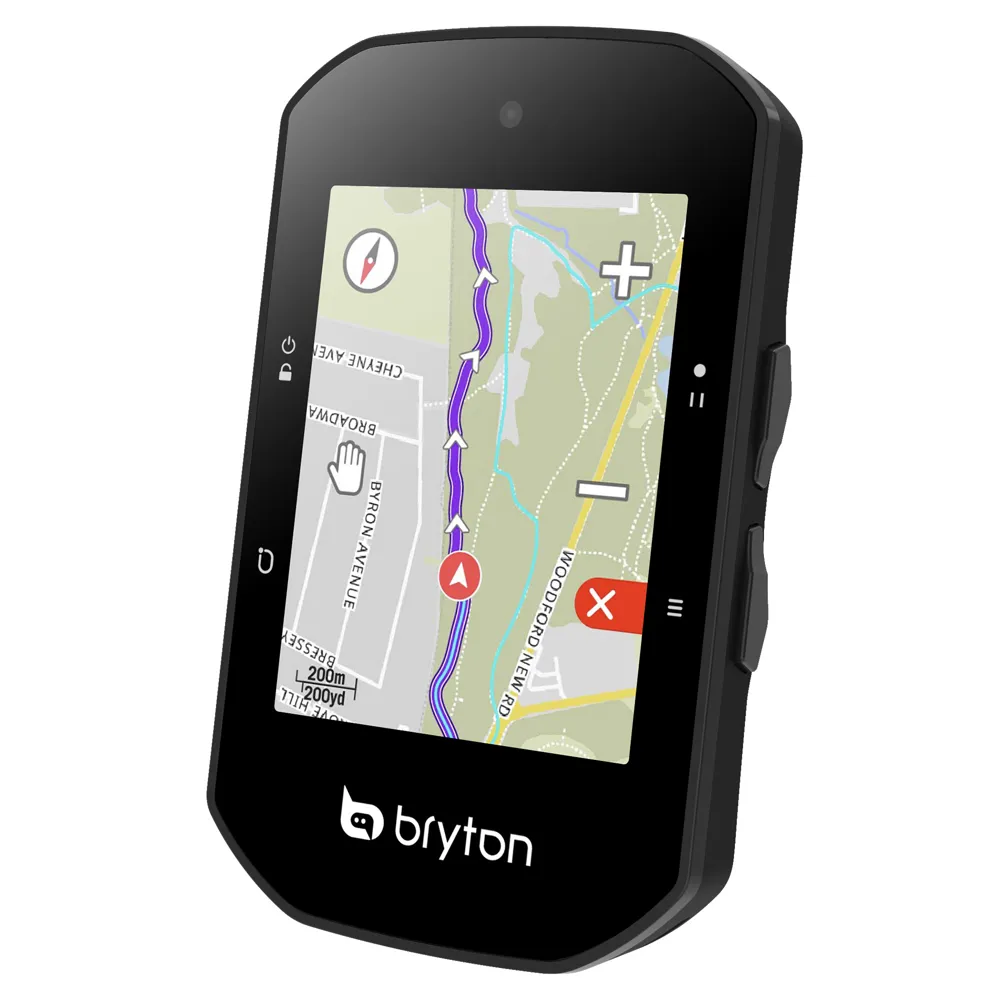
Bryton's position in this market is clear. The Rider 750 SE, per Bryton's own product page, is rated at up to 40 hours of battery life. The standard Rider 750 is rated at up to 20 hours. Both figures make every other device in this guide look conservative.
The Rider 750 supports ANT+ and Bluetooth sensors, turn-by-turn navigation, and route import. It's not in the same ecosystem bracket as Garmin or Wahoo, and the app workflow is less polished. For multi-day bikepacking where battery life outweighs app elegance, the 750 SE is the most pragmatic choice at any price. For the money, nothing else comes close.
Value check: Bryton is already priced well below Garmin and Wahoo at full RRP. Even a modest 15% discount makes the 750 SE exceptional value-for-battery.
Battery life deep-dive: what to expect on real UK rides
| Device | Manufacturer-rated battery | Notes on real-world reduction |
|---|---|---|
| Garmin Edge 840 Solar | 32 hrs (intense mode) / 60 hrs (battery saver) | Multi-band GPS and active routing reduce runtime toward lower end of intense range |
| Wahoo ELEMNT ROAM v2 | 17 hrs | ANT+ sensors + Bluetooth tracking reduces by ~25-35% |
| Wahoo ELEMNT BOLT v2 | 15 hrs | Similar reduction profile to ROAM v2 |
| Wahoo ELEMNT (v1) | 16 hrs | Older unit; still competitive for straightforward road use |
| Hammerhead Karoo 2 | 7-14+ hrs | Wide range; touchscreen brightness is the biggest variable |
| Bryton Rider 750 | 20 hrs | Conservative screen settings maintain this figure reliably |
| Bryton Rider 750 SE | 40 hrs | Multi-day trips without charging are genuinely viable |
Sources: Wahoo Fitness Support "ELEMNT, BOLT, and ROAM FAQ"; Garmin Edge 840 Solar product page; Hammerhead Support "Karoo 2 Battery Life Expectations" (8 Sept 2023); Bryton Global Official Rider 750 and 750 SE product pages.
For a typical 6-hour UK sportive with a power meter, heart rate strap, Bluetooth live tracking, and active routing at moderate screen brightness, expect roughly 60-70% of the manufacturer-rated figure. The Edge 840 Solar comfortably clears 6 hours; the ROAM v2 does too with headroom to spare. The Karoo 2 at heavy usage sits toward its 7-hour floor, so the Karoo 3's improved battery matters for longer days.
Navigation and mapping: what 'good' looks like for UK roads and gravel
Road riding
Turn-by-turn clarity is the baseline requirement. All devices reviewed here deliver it. The difference is in the incidental experience: how readable is the map at a glance at 25 mph? Can you set up data fields alongside the map without the text becoming illegible? Garmin's Cycling Map and Wahoo's mapping both handle UK roads well with clean turn prompts and audible alerts.
ClimbPro (Garmin) earns its reputation on hilly routes: it shows the current climb's length, gradient, and remaining distance as you ride it. If your weekends include the Peak District, Cotswolds, or any significant Welsh roads, this feature alone is worth considering.
Gravel and mixed surface
Hammerhead's surface-type overlays give a genuine edge over Garmin and Wahoo when planning gravel routes. Seeing which segments of a route are unpaved versus surfaced, before and during the ride, is useful for managing pace, nutrition, and tyre choice.
Offline maps are available on all premium devices reviewed here. In practice, 'offline' means pre-downloaded vector or raster map data that doesn't require a phone signal to render during navigation. This is standard behaviour on Garmin, Wahoo, and Hammerhead devices for UK mapping; the device stores maps to internal storage and routes without any mobile connection. Bryton also supports offline navigation, though map tile resolution and point-of-interest depth vary by device tier.