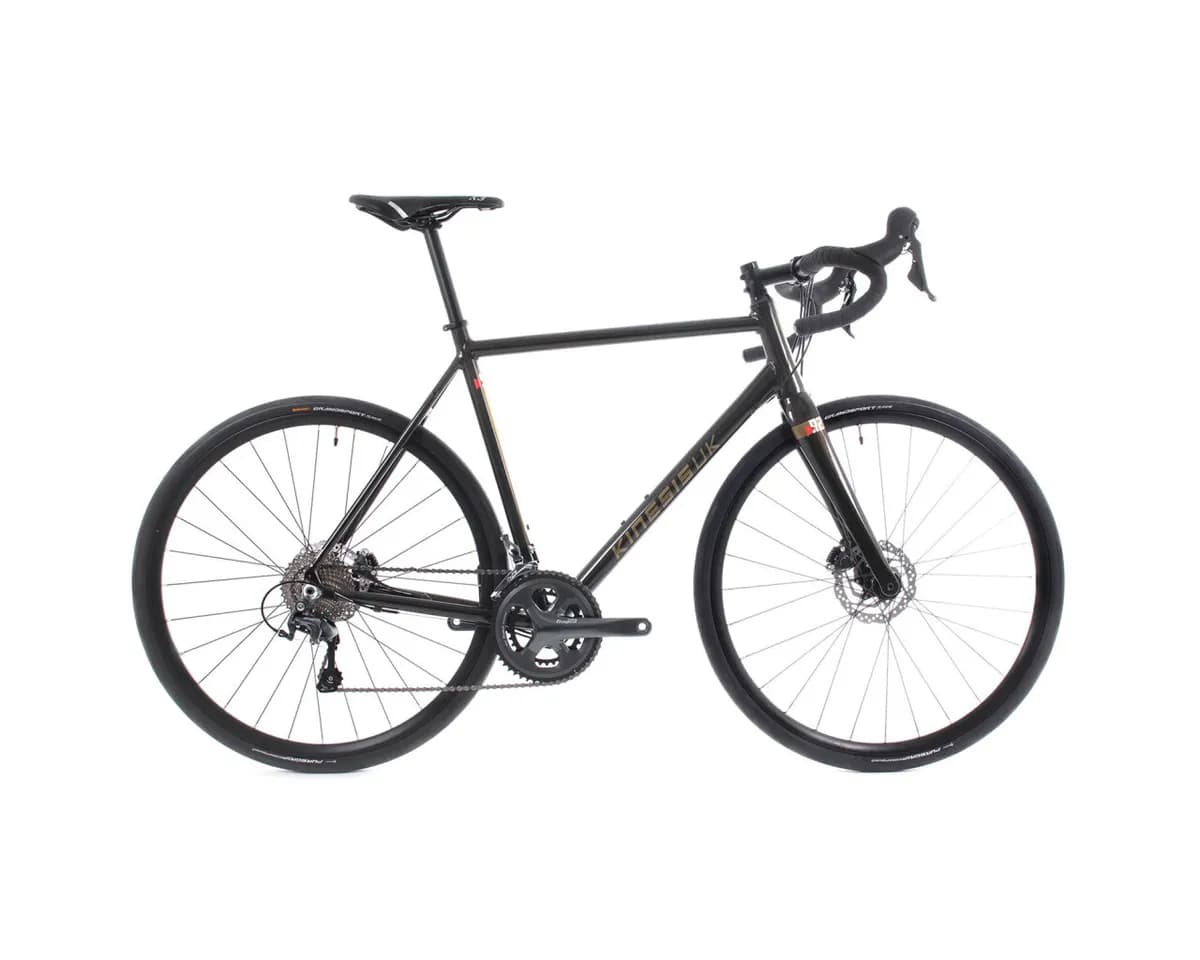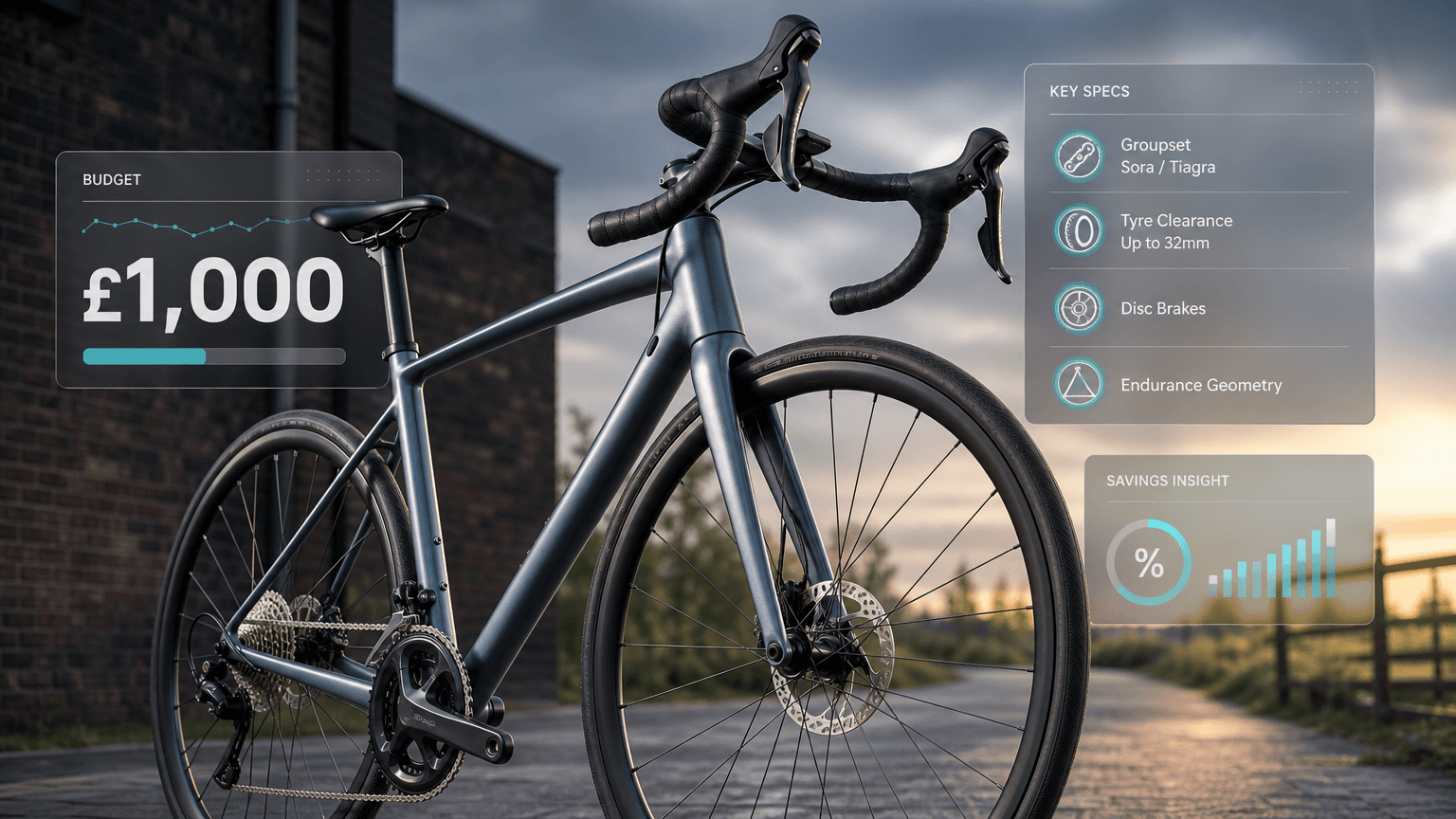
Spending £1,000 on a road bike is a significant decision, and the UK market makes it genuinely complicated. There are dozens of options, prices shift with seasonal clearances, and the same model can sit at vastly different price points across retailers on any given week. This guide cuts through that: it tells you exactly what specs to prioritise at this budget, which brands consistently deliver real value, and where to find current discounts from UK retailers without spending an afternoon trawling multiple sites.
This guide is for UK cyclists buying new (or ex-display/clearance) at up to £1,000. It assumes you're comfortable shopping online and want to make a confident, spec-informed decision rather than guessing from a shop floor.
Quick picks: best road bikes under £1,000 by use case
Before getting into the detail, here's where the sub-£1k market lands for three common buyer types:
| Use case | What to look for | Why |
|---|---|---|
| Endurance all-rounder | Aluminium frame, Sora/Tiagra, disc brakes, 28–32mm tyre clearance | Relaxed geometry + clearance = comfort on long UK rides and mixed surfaces |
| Best value beginner racer | Aluminium, Sora 9-speed minimum, rim or mech disc, 25–28mm tyres | Snappy handling, lighter build, good upgrade path |
| Mixed-surface confidence | Aluminium, Claris/Sora, mechanical disc, 32mm+ clearance | Stable geometry, mudguard mounts, tyre room for all-season riding |
And a snapshot spec comparison of what you're typically choosing between at this price point (sale pricing, as this is where sub-£1k becomes realistic for better-spec models):
| Feature | Budget end (~£500–700) | Mid-range (~£700–1,000) | Clearance/discounted |
|---|---|---|---|
| Frame | Aluminium | Aluminium (better tubing) | Occasionally carbon |
| Groupset | Shimano Claris (8sp) | Shimano Sora (9sp) or Tiagra (10sp) | Tiagra or 105 (10–12sp) |
| Brakes | Rim or mechanical disc | Mechanical or hydraulic disc | Hydraulic disc common |
| Tyre clearance | 25–28mm | 28–30mm | 28–32mm on endurance models |
| Wheel size | 700c | 700c | 700c |
| Best found at | Decathlon, Halfords | Evans, Merlin, Ribble | Sigma Sports sale, Merlin clearance |
For live discounted road bikes updated daily, Cycling Deals UK tracks deals across UK retailers so you can see exact sale price, RRP, saving percentage, and available sizes in one place.
What to look for when buying a road bike under £1,000
Frame material: aluminium dominates, carbon is a bonus
At this budget, aluminium is the standard. That's not a compromise. Modern hydroformed aluminium frames from brands like Giant, Trek, and Merida ride well and weigh less than you might expect. The alloy-vs-carbon argument matters far more at £2k+.
Carbon does appear under £1k, but almost exclusively through clearance or model-year discounts. If you spot a carbon frame with a credible groupset at this price, check: (1) the discount is genuine (compare against retailer's historical pricing), (2) your size is actually available, and (3) it isn't an older model with spec you'd want to upgrade immediately. Those costs add up fast.
Groupset tier: Claris vs Sora vs Tiagra vs 105
This is where the decision matters most day-to-day.
Shimano Claris (8-speed) is the entry tier. Shifting is reliable but lacks the precision of higher groups. Upgrade headroom is limited because 8-speed cassettes are a dead end for most upgrade paths. Fine for a first bike, but if you're committing to regular riding, push past it if budget allows.
Shimano Sora (9-speed) is the sweet spot for sub-£1k. It shifts cleanly, uses standard 9-speed components (widely available for replacement), and is a genuinely satisfying groupset for training rides, sportives, and commutes. Most new bikes at £700–900 RRP ship with Sora.
Shimano Tiagra (10-speed) is a meaningful step up. More tactile lever feel, better cable pull consistency, and compatibility with a wider range of 10-speed components. At this budget, Tiagra usually appears through clearance on bikes that originally retailed at £1,200–1,500.
Shimano 105 is rare below £1k at current RRP but appears regularly on sale/clearance stock. If you find it in your size at or below £1,000, it's almost always the best value option at this budget. The 105 12-speed chainset retails at £160 alone when discounted, which illustrates how much groupset value you're getting when a full bike ships with it.
Brakes: mechanical disc vs hydraulic disc vs rim
Rim brakes are lighter, lower maintenance, and still found on many entry road bikes. On dry UK roads they work very well. In wet conditions they are measurably worse than disc, and tyre options are constrained by clearance around the rim.
Mechanical disc brakes give you disc braking feel and all-weather confidence without hydraulic complexity. The trade-off is a spongier initial lever feel compared to hydraulic. For a first road bike or anyone who services their own bike, mechanical disc is very practical.
Hydraulic disc brakes offer the sharpest modulation and least maintenance once bled correctly. On clearance bikes at this price point, hydraulic disc is increasingly common. The caveat: a bleed kit and the first bleed service isn't free. Factor that in if you're buying clearance stock that might need attention.
For UK riding, disc brakes (mechanical or hydraulic) are the pragmatic choice for anything used year-round.
Tyre clearance: 28mm is the minimum, 30–32mm is the target
This is probably the most under-appreciated spec in UK road bike buying guides. Road surfaces in Britain are not smooth. A bike that only accepts 25mm tyres will deliver noticeably harsher rides than one accepting 28–30mm, and the rolling resistance difference at these widths is negligible at sub-race speeds.
Check the manufacturer's stated maximum tyre width, not just "road bike" as a category. Endurance geometry frames (longer wheelbase, more relaxed head angle) almost always offer more clearance. Race-positioned frames sometimes cap at 25–28mm. If you plan to run 28mm, 30mm, or even 32mm tyres for UK roads, confirm clearance is listed as adequate before you buy.
Geometry and fit: endurance vs race position
Race geometry prioritises aerodynamics: lower front end, shorter head tube, more forward position. This is fast but tiring on long rides and unforgiving on rough roads.
Endurance geometry raises the front end, lengthens the wheelbase slightly, and often increases tyre clearance. It's more comfortable over 3+ hours and far more forgiving. For most people buying a road bike under £1k for training, sportives, or regular commuting, endurance geometry is the better fit.
You don't need to get lost in stack and reach numbers. The practical shortcut: if the manufacturer describes the bike as an "endurance" or "sportive" model, it's endurance geometry. If they describe it as a "race" or "performance" bike, confirm the head tube length before committing.
Size still matters more than geometry. A misfit endurance bike is worse than a correctly-sized race bike.
Wheels and tyres: upgrade the tyres first
Stock wheels on sub-£1k bikes are adequate but rarely exciting. The actual quality difference between a £1k and £2k bike's wheels is real, but it matters less than you think for most riding. What matters immediately is the tyre.
Swap the stock tyres for a quality Continental GP5000, Pirelli P Zero Race, or Schwalbe Pro One and the bike will ride noticeably better. Budget £50–80 for a pair of quality road tyres post-purchase, especially if the stock rubber is a generic OEM tyre. That's where first-year upgrade money should go. You can browse discounted road tyres and wheelsets for further savings.
Warranty and returns on sale/clearance stock
Sigma Sports is explicit about this on their sale/clearance pages: all bikes receive a professional pre-delivery inspection (PDI) and carry manufacturer warranty regardless of sale status. That's the standard you should expect from any reputable UK retailer.
Check:
- Is the manufacturer warranty still honoured? (Yes, for new bikes, even on clearance)
- What is the retailer's returns window for an online purchase?
- Is a PDI confirmed? (Most specialist retailers do this; big-box stores are less consistent)
Brands that usually offer the best value under £1,000
The honest answer is that "best brand" at this budget means "best spec for your size at the best current price." Brand loyalty is less important than the frame-groupset-brake-clearance combination available in stock in your size on the day you buy.
That said, some names consistently deliver more spec per pound:
Boardman (Halfords): own-brand bikes that frequently appear on sale. Aluminium frames are well-finished, and groupset spec often outpaces equivalently priced named-brand alternatives. Worth checking Halfords' sale page regularly.
Specialized Allez: consistently one of the best aluminium road frames in this segment. Full RRP is usually above £1k for the disc version, but clearance and sale stock (particularly older-model-year Allez Sport or Allez base) regularly appears at or below this budget. Frame quality is a genuine class leader.
Trek (Domane/Checkpoint entry-level): Trek's endurance geometry bikes offer a well-sorted ride with solid dealer aftercare. Look for previous-year models.
Giant (Contend series): Giant's direct-supply model means their bikes deliver better frame quality per pound than many competitors at full RRP. The Contend series is the usual entry point.
Cube, Merida: both German/Taiwanese-designed brands with consistently reliable component spec at entry price points. Often the best-value bikes in Merlin Cycles clearance.
Cannondale (CAAD or Synapse entry): aluminium CAAD frames are lightweight and precise. When they appear on clearance, they're compelling.
Triban/Decathlon: the Van Rysel Triban RC120 and similar Decathlon models are the budget benchmark. You won't find better spec per pound at the very bottom of this price range, period.
Where value traps appear: watch for heavily padded RRP (a bike listed at "£1,299, now £999" where the original price was set inflated), heavy frames positioned as performance bikes, and poor-quality stock wheels dressed up with a mid-range groupset. A strong groupset on a heavy, flexy frame is a poor trade.