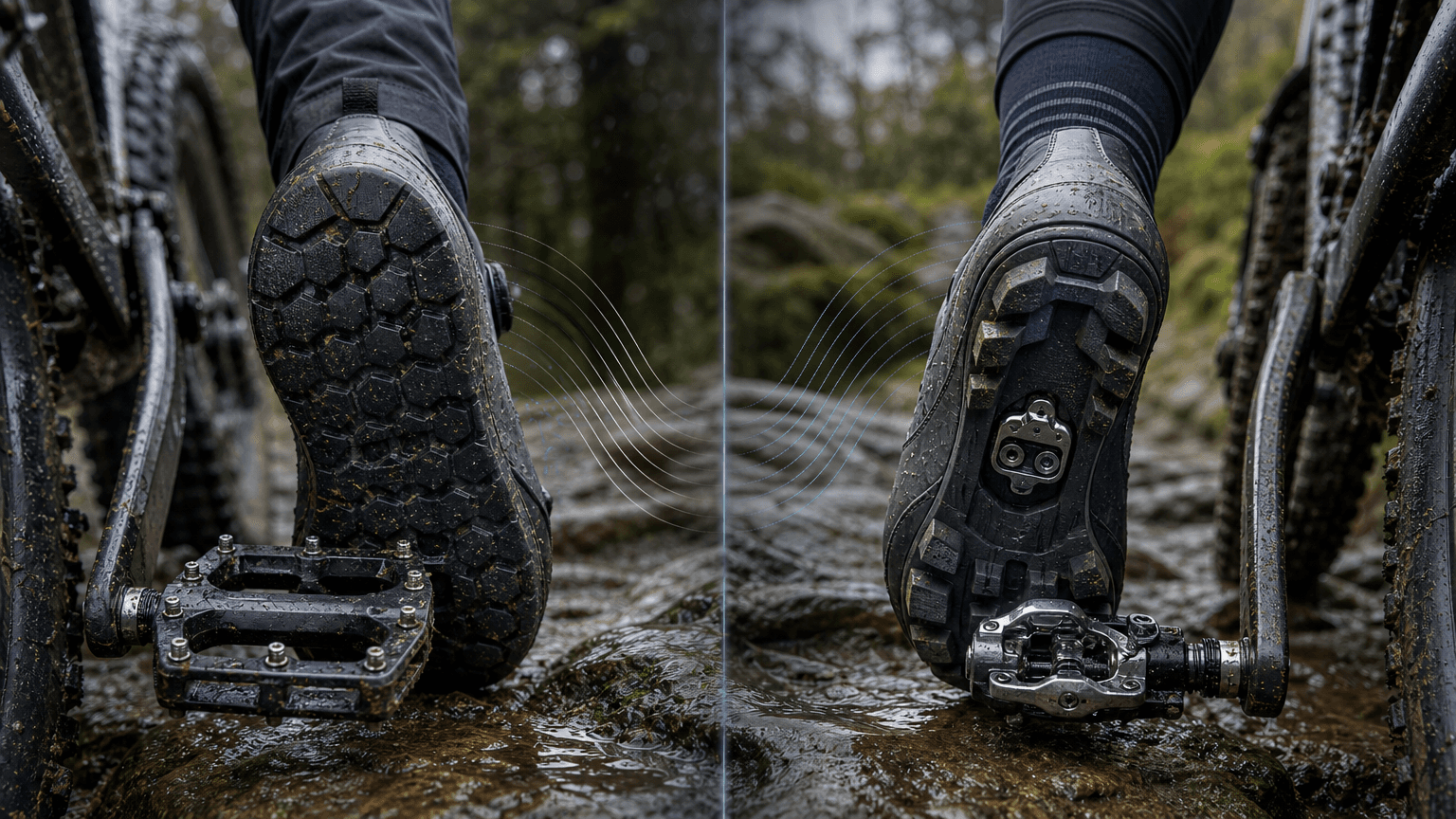
Quick picks: flat vs clipless for UK trail and enduro
Before getting into detail, here is the short version. If you ride UK trails regularly, the decision splits cleanly into two columns:
Flat-pedal winners:
- Best for wet grip and hike-a-bike: Five Ten Trailcross (Stealth Phantom outsole, medium-stiff midsole)
- Best for UK winter riding: Five Ten Trailcross GTX (Gore-Tex membrane + Stealth Phantom, confirmed by Pinkbike and MBR coverage, Aug 2021)
- Best for wide feet: Ride Concepts Accomplice BOA (generous toe box, single-dial closure for easy volume adjustment)
- Best all-day trail shoe: Fox Union BOA (structured midsole, flat-specific tread, BOA dial for micro-adjustment)
Clipless (SPD) winners:
- Best enduro control + walkability: Shimano GE9/GE-line (ULTREAD GE outsole, moulded pedal channel, purpose-built for slippery hike-a-bike sections)
- Best SPD trail shoe: Five Ten Kestrel BOA (named by BikeRadar's 2026 tested guide as a top trail/enduro pick)
- Best clipless winter boot: Shimano MW7 or Northwave Celsius equivalent (insulated upper, membrane waterproofing, ankle cuff seal)
- Best clipless for walkability: Crankbrothers Mallet E Lace (recessed cleat pocket, flexible forefoot, lace closure for precise volume control)
Not sure which system suits you? Answer three questions:
- Do you unclip and put a foot down on most technical features? If yes more than twice per descent, flat pedals are genuinely better for your riding.
- Do you walk the bike more than 20 minutes per ride? Flat pedals or recessed-cleat clipless shoes win here.
- Is your riding mostly autumn-to-spring in the UK? Waterproof membrane models are worth the small breathability trade-off.
Sole stiffness: power transfer vs walking comfort
Sole stiffness is the single most misunderstood spec in MTB footwear. It determines how efficiently your leg power moves into the pedal, but it also determines how much your foot bends when you're walking a technical section or carrying the bike up a loose climb.
Shimano's stiffness index gives a useful framework. Per Ride Shimano's published explanation, shoes rated at 12 on the index provide the most efficient pedalling dynamics, engineered to limit torsional and lateral flex while maximising power transfer. That figure is relevant for XC racing and technical enduro stages where every watt counts. For UK trail and enduro riding, where you're also scrambling over wet rock steps and walking bog sections, a mid-range stiffness is the more practical choice.
The stiffness comes from two components: the outsole material and construction, and the midsole shank (a stiff insert that runs from heel to ball of foot). On flat-pedal shoes, the outsole is softer by design to allow pin engagement across more of the rubber surface. On SPD shoes, a stiffer shank is needed to stop the foot flexing around the cleat interface, which causes hotspots and energy loss on longer climbs.
Practical decision guide:
- Trail riding, mixed terrain, regular hike-a-bike: choose medium stiffness. You want enough rigidity to pedal efficiently but enough forefoot flex to walk without shuffling.
- Enduro racing or long technical descents: go stiffer. A rigid sole stops foot flex under heavy braking and rough pedalling forces.
- Winter/muddy conditions with lots of off-bike time: prioritise walkability over stiffness. A boot-like sole with a toe rocker makes hike-a-bike sections far less exhausting.
One warning that applies to both systems: cleat hotspots on clipless shoes are almost always a stiffness mismatch, not a fit problem. If your foot aches around the ball after an hour of climbing, the shoe is too flexible and your foot is rolling around the cleat.
Grip that works on UK trails (wet roots, rocks, and mud)
UK trail grip conditions are different from the dry, loose-over-hard terrain where many American-spec MTB shoes are designed. British trails combine wet sandstone, slippery limestone, root networks that turn glassy in rain, and soft clay mud that packs into lugs. The outsole compound and tread pattern both matter.
For flat pedals, the outsole compound is the primary grip mechanism on the ground, and the pedal pins do the work on the bike. Five Ten's Stealth rubber (particularly the Stealth Phantom blend used on the Trailcross line) is the benchmark for flat-pedal pin engagement. The rubber is soft enough to conform around pin tips and bite into wet rock, but the compound also performs on the walk sections between features. Ride Concepts uses a similar sticky rubber strategy on their Livewire and Hellion compounds, and Fox Union's flat-specific outsole performs well on UK loam and rock slabs.
For clipless shoes, the picture is different. The cleat recess matters as much as the outsole compound. Shimano's GE9 line specifically features a moulded pedal channel for a stable shoe-to-pedal connection, plus an ULTREAD GE compound on the toe and heel zones to grip on wet rocks and roots when you're unclipped or scrambling. The tread lug height in the toe and heel areas also determines how well mud clears. Deep, spaced lugs clear better; shallow, close-spaced lugs grip hard surfaces better. For UK conditions, the mid-lug profile is the right compromise.
A practical test for grip quality on any MTB shoe: press your thumbnail firmly into the outsole rubber. Stealth-class rubber will show a clear thumbnail impression and recover slowly. Harder compounds recover immediately and offer noticeably less wet-ground traction.
Walkability and hike-a-bike comfort
This is the section that most buying guides underserve, yet for UK riders it's often the deciding factor. Many British trail centres and natural singletrack routes include hike-a-bike sections that are a significant part of the ride. A shoe that's brutal off the bike turns a good day into a long one.
Three things determine walkability:
Flex points. The shoe needs to bend where your foot naturally bends during walking, which is at the ball of the foot. A shank that extends all the way to the toe creates the penguin-shuffle gait that makes stiff SPD road shoes infamous. MTB-specific sole construction typically stops the rigid shank behind the ball-of-foot area, allowing forefoot flex.
Toe rocker profile. Shoes with a slightly upturned toe (the rocker) roll your foot forward naturally when walking. Flat, square-toed soles force you to push off the toe tip, which is uncomfortable over any distance.
Cleat recess depth (SPD shoes). The deeper the cleat sits into the sole, the flatter the shoe walks. Road SPD-SL shoes have almost no recess, which is why they're famously bad for walking. Enduro-specific SPD shoes typically recess the cleat 5-8mm so the rubber sole contacts the ground first, not the metal cleat.
Boot-height vs low-profile is a separate consideration. A mid-cut or boot-height shoe (like the Shimano MW7 or Northwave Celsius XC Arctic SBS) adds ankle support and keeps debris out on long descents. The trade-off is reduced ankle flex during walking and slightly more weight. For hike-a-bike-heavy routes, a low-profile shoe with good flex points is faster on foot. For rock-armour and root-infested UK winter trails, the ankle support is worth it.
Weather protection in the real world
UK riders need to be honest about what 'waterproof' means in practice. A Gore-Tex membrane keeps your foot dry in moderate rain and shallow water crossings. It does not keep your foot dry if you ride through a knee-deep ford, if water pours in over the ankle collar, or if the cuff seal has degraded through heavy use.
The Five Ten Trailcross GTX pairs a Gore-Tex membrane with the Stealth Phantom outsole, making it the best-evidenced waterproof flat-pedal shoe for UK conditions (covered by both Pinkbike and MBR in August 2021). The Gore-Tex liner handles trail rain and puddle splashes effectively, but the critical detail is the cuff closure: if your waterproof shoe has a loose or low collar, water runs straight down the leg into the shoe during a hard rain-ride. Look for a gusseted tongue, a snug ankle collar, and ideally a sock-liner construction that eliminates internal seams as entry points.
The practical breakdown for UK weather:
| Condition | What you need |
|---|---|
| Spring/autumn wet rides (5-12°C, persistent rain) | Waterproof membrane shoe, no insulation required |
| Summer British rain (15°C+) | Water-resistant shoe or light membrane; breathability matters more |
| Winter riding (0-5°C, wet and cold) | Insulated winter boot with sealed cuff and drainage ports |
| Deep winter (sub-zero, ice) | Neoprene-lined boot or winter-specific overshoe over a trail shoe |
Breathability trade-off is real. Gore-Tex breathes, but less than a mesh upper in warm weather. If you ride in UK summer showers, a water-resistant (not waterproof) shoe with DWR coating often performs better because it sheds light rain and still breathes when you're climbing.
Re-treating DWR: most waterproof shoes lose their DWR coating after 20-30 rides. Nikwax Footwear Proof spray (applied after washing) restores the surface water repellency and extends membrane effectiveness by stopping the outer fabric from saturating. This is especially important if you notice your shoe upper 'wetting out' even though the membrane is still intact.


