The best way to compare cycling product discounts from UK bike shops is to start in a hand-checked deals feed that shows was/now prices from several retailers side by side. Then confirm the winner on the retailer's own product page. A single shop's sale page can't do the first job, and a deals feed can't do the second. You need both, in that order.
This comparison is for UK road, gravel, mountain and e-bike riders who research before they spend. That includes people upgrading wheels, groupsets, framesets or kit. We compare four types of option against the same criteria: a multi-retailer deals feed (Cycling Deals UK), a curation site (Bike Bargains), another UK deals site (Bikesy) and single-retailer sale pages (Tredz, Merlin, Sigma Sports, Leisure Lakes and similar shops).
Why one retailer sale page is a poor way to compare discounts
A retailer sale page answers one question: what is this shop discounting today? It can't tell you whether another UK shop has the same item for less, or whether a bigger percentage off simply reflects a higher starting price.
Comparing by hand makes it worse. You open one shop's sale section, then another's, and the same product can appear under slightly different names. Model years change, colours and finishes differ, and a size that's in stock in one place is gone in another. Delivery charges, returns terms and offer conditions also vary by shop. By the fourth tab it's easy to compare two products that aren't quite the same.
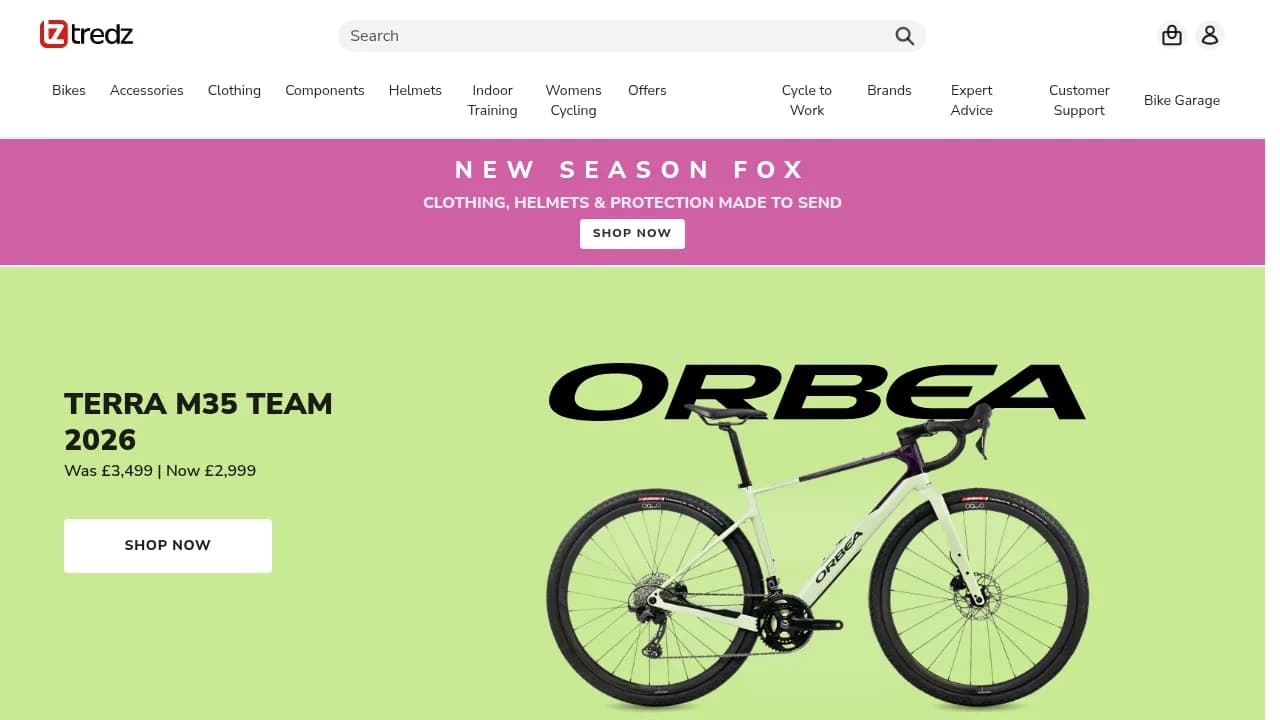
Major UK retailers such as Tredz, Merlin, Leisure Lakes and Sigma Sports are built to sell. Their homepages are product catalogues and promotional hubs. They do that job well, but they have little content on how to compare discounts across shops, and none of them consolidates rival retailers' prices for you. That isn't a criticism. It's the job they're designed for.
The rest of this guide sets out the signals that matter and a short workflow for using them.
The five signals that separate a useful comparison from a pile of tabs
Whether you're using a discount comparison site, a price tracker or a spreadsheet, judge it on these five points.
Coverage across retailers and categories
A useful source pulls offers from several UK bike shops and spans bikes, framesets, groupsets, wheels, components, clothing and accessories. Narrow coverage means you're still doing the comparing yourself, and you may miss the best price because it sits at a shop the source doesn't track.
Freshness
Cycling discounts move quickly, especially on season-specific stock and premium brands. A "latest deals" feed that's visibly current is far more useful than a static sale landing page that may be days out of date. Look for clear signs the listings are maintained.
Was/now pricing
A saving is only measurable if you can see both numbers: the original price (or stated RRP) and the current sale price. A bare "30% off" badge tells you almost nothing. You can't judge it without knowing 30% off what.
Sort by saving
When there are thousands of offers, scanning manually isn't realistic. You want to sort by biggest discount or biggest saving and work down from there. This is the single biggest time-saver in the whole process.
Price history and verification
Price history is the best defence against an inflated RRP. If a deal listing or product page shows what an item has actually sold for, check that before trusting the "was" price. Not every source offers this, so treat it as a bonus rather than a baseline. Where it isn't available, comparing the same item across several retailers is the next best check.
Cycling Deals UK: the best place to start your comparison
Cycling Deals UK is a UK-focused deal discovery and curation site. It collects discounted products from British cycling retailers in one place, including complete bikes, framesets, clothing, components, accessories and cycling tech. It doesn't sell anything. Each listing links out to the retailer's own product page, and each shows the retailer's name, such as Sigma Sports or Merlin Cycles.
That separation matters. Cycling Deals UK handles comparison. The retailer handles purchase confirmation. You find the candidate in one view, then click through to check the details at source.
Against the five signals, the live deals feed works like this:
Coverage: offers from multiple UK retailers, browsable by category (bikes, clothing, components, accessories), with dedicated discovery for road, gravel, mountain and e-bikes.
Freshness: a curated "latest deals" feed with daily updates to featured offers.
Was/now pricing: each listing shows the sale price, original price and total saving.
Percentage discount: shown on each listing, so you can compare offers quickly.
Size availability: shown on selected product listings, which saves clicks on fit-sensitive items such as bib shorts and jerseys.
The deals are hand-checked. That's the reason to prefer this feed over browsing sale pages at random: someone has looked at the offers before they reach you. For breadth, the biggest cycling discounts collection lists thousands of offers from UK retailers (4,120 at the time of writing), which is exactly the kind of volume where sorting by saving earns its keep.
There are limits. Cycling Deals UK is a discovery layer, so you can't check out there. Its listings are a starting shortlist, and you still need the retailer page to confirm stock, delivery and offer terms. Its coverage is also limited to the retailers it tracks, so a small independent shop with a one-off clearance won't necessarily appear.
How Bike Bargains, Bikesy and retailer sites differ
These options are often lumped together in searches for "uk cycling discount comparison sites". They do different jobs.
Bike Bargains
Bike Bargains presents itself as a UK-focused cycling bargains curation site, with category browsing across bikes, clothing, components and accessories. Its transparency and disclosure content helps build trust, and the category structure is easy to follow. Based on our analysis, it leans towards explanatory pages rather than comparison mechanics. We found less evidence of strong freshness signals, sort-by-saving workflows or price-history context. It's a reasonable place to browse, but it asks you to do more of the comparing yourself.
Bikesy
Bikesy is another UK cycling deals site. It uses category and brand tiles and sends you out to retailers, which makes it a useful second look if you already know the brand you want.
It is thinner than Cycling Deals UK: less reliable was/now pricing, no sort by biggest saving, and no price history. Fine as a second tab. Not a replacement for a sortable feed. The UK deal websites comparison and the Cycling Deals vs Bikesy guide go further.
Retailer sale pages
Tredz, Merlin, Sigma Sports, Leisure Lakes and Wiggle are strong places to buy. They offer large catalogues, clear navigation, trust signals and, on many products, review content and discount tags. Their weakness is the one described earlier: you only see what that shop is selling. They're the right place to confirm a deal and complete a purchase, and the wrong place to find out whether it's the best deal in the UK.
Once you've learned the checklist, the broader best UK cycling deals websites guide compares more aggregators, including Bikesy and Bike Bargains, by coverage and ease of use.
A 60-second workflow to compare discounts properly
Filter to the exact product type and variant you need. Pick the category, then note the frame size, component model or clothing size before you look at any prices.
Sort by biggest saving. This surfaces the most promising offers first, so you're not scrolling through thousands of listings.
Open your top two or three candidates on the retailer's product page. Check the model number, colour and model year match, and confirm your size is available. Look at delivery costs, returns terms and any conditions attached to the offer. If you want price matching, check each retailer's policy, as terms differ.
Sanity-check the "was" price. If the product page or another tool shows price history, use it. If not, compare the "was" price against the same item at other retailers in the feed.
Choose the best deal for your exact variant, not the best-looking percentage. A 40% saving on the wrong size or the previous model year isn't a better deal than 25% off the right one.
If you're timing a big purchase, the Black Friday cycling deals guide covers what's worth waiting for and where to compare live offers. The same workflow applies.
Comparison table: how your options stack up
Criteria
Cycling Deals UK (deals feed)
Bike Bargains (curation site)
Bikesy (deals site)
Single retailer sale pages
Multi-retailer comparison
Yes, offers from several UK retailers in one feed
Curated across retailers, mostly category browsing
Partial, brand and category tiles
No, one shop only
Was/now pricing and saving
Sale price, original price and total saving on listings
Less evidence of on-page was/now comparison
Partial
Usually shown, for that shop only
Percentage discount visible
Yes, on each listing
Varies
Inconsistent
Usually, on products
Sort by saving
Built around browsing the biggest discounts
Less evidence of sort-by-saving
No
Sort options vary by shop
Freshness signals
"Latest deals" feed, daily updates to featured offers
Fewer clear freshness signals
Partial
Current, but only for that shop
Price-history support
Check the product page or retailer for context
Limited
No
Rarely cross-retailer
Sells products?
No, links out to retailers
No
No
Yes
Best for
Finding and shortlisting the best saving
Browsing curated categories
A second look by brand
Confirming and buying
Pros and cons at a glance
Cycling Deals UK
Pros: one view across UK retailers, clear saving data, retailer attribution, hand-checked offers, sizes on selected listings, direct links to the source.
Cons: you can't buy on the site, and it only covers the retailers it tracks.
Bike Bargains
Pros: clear UK cycling focus, easy category navigation, transparent disclosures.
Cons: more explanatory than comparison-led, with limited sort and freshness mechanics.
Bikesy
Pros: visual brand and category tiles, outbound links to UK retailers.
Cons: thinner catalogue, no reliable sort by saving, no price history.
Retailer sale pages
Pros: you can buy there and then, and they carry large catalogues, reviews, delivery and returns information.
Cons: you only see one shop's prices, so cross-shop comparison is manual.
FAQ: quick answers on comparing cycling discounts
Does Cycling Deals UK sell bikes or other products?
No. Cycling Deals UK is a discovery and curation site. Every listing links to the retailer's product page, where you complete the purchase and where delivery, returns and stock are handled.
Can I trust the RRP shown on a deal?
Treat an RRP as a claim to check, not a fact. A stated RRP is a useful starting point, but some retailers use inflated "was" prices to make a discount look larger. Cross-check it against the same product at other UK retailers and, where available, against price history.
How do I spot inflated RRPs on cycling discounts?
Look for three signs. First, the same item sells for broadly the same price at several shops, even though only one claims a huge saving. Second, a "was" price that no retailer seems to have charged recently. Third, a percentage that looks too large for the product category or model year. Comparing across retailers in a feed is the quickest way to catch all three.
What should I check on the retailer's page before buying?
Check the exact model name and year, colour, and your size. Then check delivery cost and timing, the returns policy and any offer conditions. If price matching matters to you, read the retailer's policy rather than assuming it applies.
Is the percentage discount reliable without was/now pricing?
No. A percentage on its own hides the starting price. Two products can both show 30% off, yet one may be cheaper in pounds by a wide margin. Always compare the actual sale prices for the same variant, and use the percentage only to sort and shortlist.
What if the product variant differs between retailers?
Don't compare the prices as if they were equal. Different sizes, colours, model years or specs make the comparison unfair. Match the model number where possible. If you can't, treat the listings as separate options and weigh the price difference against what you'd actually get.
Where to start
Open the live Cycling Deals UK feed, filter to the product and size you want, and sort by biggest discount. Take the top two or three offers to the retailer product pages, check the variant and terms, and look at price history if it's shown. Buy from whichever shop gives you the right item at the best verified price.