Picking the right women's road bike in 2026 starts with geometry and sizing, not colour options or spec sheets. Get those wrong and no amount of upgrading components fixes the discomfort. Get them right and even a mid-budget aluminium frame becomes a genuinely fast, comfortable machine. This guide covers fit, women-specific geometry, how to size correctly using stack and reach, which brands to look at, and where to find current UK deals without hunting across a dozen retailer sites.
Best Women's Road Bikes UK (2026)
6 May 2026 · Laura Mcmahon

Quick picks: the fastest way to choose
If you know your riding style and budget, start here.
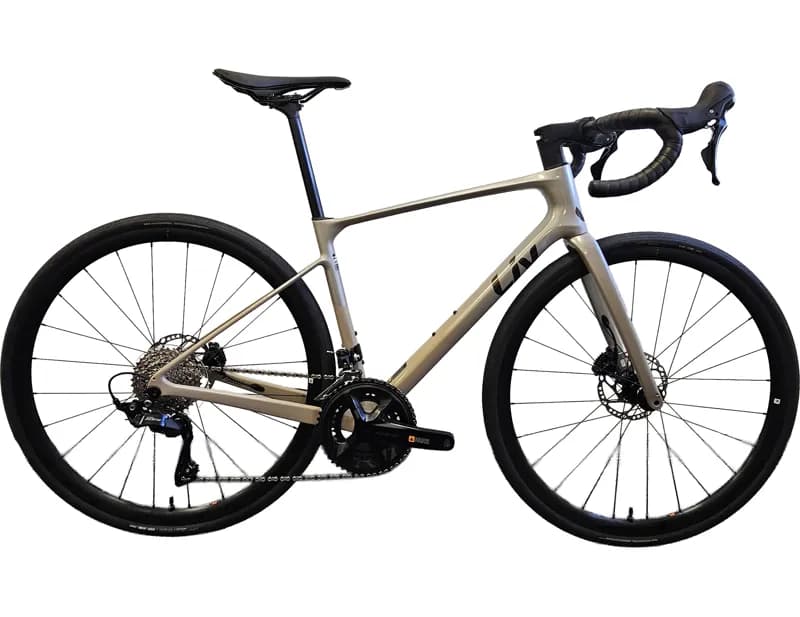
- Best race bike: Liv Langma Advanced Pro. Geometry built specifically for women's proportions, not a scaled-down men's frame. Suits riders who want a genuinely aggressive position and have the flexibility to hold it.
- Best endurance bike: Trek Domane AL (women's fit). Higher stack, longer wheelbase, forgiving on UK roads. Ideal for sportives, winter training and long days in the saddle.
- Best value: Boardman SLR 8.6 Women's Road Bike. Currently available discounted at Halfords, S/M/L sizing. A strong starting point for riders upgrading from a hybrid or first road bike.
- Best lightweight option: Specialized Tarmac SL8 (with women-specific sizing down to 44cm). Carbon frame, race-oriented, but available in sizes that work for shorter riders without the compromised geometry common in small unisex frames.
Women-specific road bikes in 2026: what actually differs
Cycling Weekly's 2026 women's road bike buyer's guide frames this correctly: women-specific bikes involve genuine geometry differences and different components, not just cosmetics. That's the right framing.
There are two distinct categories to understand.
True women-specific geometry means the frame itself is designed differently. Common changes include a shorter reach (the horizontal distance from the bottom bracket to the top of the head tube), a slightly different stack (the vertical height equivalent), and altered standover. Brands like Liv (Giant's dedicated women's brand) build every frame from scratch for women's anatomy rather than adapting an existing unisex mould.
Women-optimised touchpoints on a unisex frame means the frame geometry is the same as the equivalent men's model, but the saddle, bars, stem length and sometimes crank arms are swapped for women-specific versions at point of sale. This approach is common across Specialized, Trek, Scott Contessa and others. It's not a compromise in many cases; it depends entirely on whether the frame geometry suits your proportions.
The honest answer on which approach is better: it depends on your body proportions, not your gender. Riders with a shorter torso relative to leg length will generally benefit more from women-specific geometry. Riders with a longer torso may find the shorter reach on some women's frames actually puts them in a worse position.
Fit fundamentals before swapping any parts
Road bike fit rests on three contact points: the saddle (your sit bones and hip hinge), the bars and hoods (where your hands rest and your weight distributes), and the pedals and cleats (your foot-knee-hip alignment). Every adjustment you make ripples through the other two. This is why fixing discomfort by only swapping one part often fails.
Posture demands differ between race and endurance geometry. On a race-oriented frame with a low front end, you need more flexibility in your lower back and hamstrings to hold an efficient position without strain. On an endurance frame, the raised front end asks less of your flexibility but also reduces your aerodynamic efficiency. Neither is superior; they suit different riders and different ride types.
Height-only sizing fails a significant proportion of riders. A rider who is 165cm with a 75cm inseam needs a very different bike to a 165cm rider with an 82cm inseam. Yet most retailer size charts only list height ranges. Stack and reach numbers, taken from a brand's published geometry chart, give you a much more precise picture.
How to size a road bike properly
Step 1: Measure your height and inseam. Stand barefoot on a hard floor. For inseam, stand against a wall with a book pressed firmly up into your crotch (as if it were a saddle) and measure from the top of the book to the floor.
Step 2: Use inseam, not just height, to find your starting frame size. Multiply your inseam (in cm) by 0.665 to get a rough seat tube length target. A rider with an 80cm inseam would be looking at roughly a 53cm seat tube as a starting point.
Step 3: Compare stack and reach across models. Once you have a size range, pull the geometry chart for every bike you're considering. For endurance bikes, a higher stack (say 560-580mm on a medium) with a shorter reach creates a more upright, stable position. For race bikes, a lower stack and longer reach creates an aggressive, aerodynamic posture. Canyon's sizing guidance specifically promotes stack and reach as the most useful geometry comparison for modern bike fitting, and they're right.
Step 4: Check cockpit adjustability. A standard stem allows for roughly 3-4cm of adjustment in length (say, a 90mm stem swapped for a 110mm or 70mm). Spacers under the stem add stack height. If the geometry numbers are close but not perfect, the cockpit is where you fine-tune.
Quick home checklist:
- Height (barefoot, against wall)
- Inseam (book method, hard floor)
- Arm length (shoulder to wrist)
- Torso length (shoulder to hip crease)
- Any known flexibility limits (tight hamstrings, lower back issues)
Take those numbers to any reputable bike fitter or use them to cross-reference against a brand's published geometry table.
Sizing by scenario
Short inseam (under 75cm): You're at the boundary where standard S/XS frames may still have too-long a reach. Look for brands that publish XXS or 3XS/2XS sizes with genuine geometry scaling. Canyon's road bike range extends down to 2XS on several models with legitimately different stack and reach numbers, not just a slacker stem angle. Liv does the same. Avoid brands whose 'XS' is simply a 'S' with a shorter seatpost.
Long legs, shorter torso: A higher stack relative to reach is what you need. An endurance geometry will typically serve you better here because the front end rises to meet a naturally upright torso position. If you're on a race bike, you'll need a shorter stem and higher spacer stack to compensate.
Between two sizes: Generally, go smaller. A smaller frame with a longer stem is easier to dial in than a larger frame where you're trying to bring the bars closer. Spacers can add stack height; they can't reduce reach as effectively as a stem swap.
Feeling cramped in the drops: Check saddle fore-aft position first (pushing it back often creates more cockpit room than changing the stem), then consider a shorter-reach bar or a longer stem. Bar width also affects perceived reach: narrower bars push the hoods slightly forward.
Endurance vs race geometry on UK roads
On British roads specifically, endurance geometry earns its place. Most UK riders are not racing. They're doing sportives, club runs, long weekend rides, and plenty of riding in less-than-ideal conditions. The higher stack on an endurance frame reduces lower back load on long climbs and provides more stable handling on wet descents.
Endurance bikes also tend to run wider tyre clearances: 30-32mm tyres on a modern endurance road bike smooth out poor tarmac noticeably. Bikes like the Giant Defy Advanced, Trek Domane and Cannondale Synapse are specifically engineered around this. You can browse endurance road bike deals to see which models are currently discounted from UK retailers.
Race geometry rewards fitness and flexibility. The lower front end creates less aerodynamic drag and a stiffer power transfer, but you feel every bump more acutely. On UK roads, unless you're training seriously or racing, most riders are better served by a slight endurance bias.
Brands to look for (UK availability)
| Brand | Approach | Sizes available | Known for |
|---|---|---|---|
| Liv (Giant) | True women-specific geometry | XXS to XL | Frame geometry designed from scratch for women |
| Canyon | Unisex frames + women touchpoints on some models; very wide size range | 2XS to 3XL | Exceptional size range, direct-to-consumer value |
| Scott Contessa | Women-specific geometry on Contessa line | XS to L | Climbing-oriented; lightweight options |
| Specialized (women's line) | Women-specific touchpoints; some WSD geometry on smaller sizes | 44cm to 61cm | Wide model range; Body Geometry saddle and shoes |
| Trek (women's geometry) | Isospeed endurance tech; women-specific sizing on Domane/Émonda | 47cm to 62cm | Endurance comfort; wide UK retailer availability |
Where unisex works: If you're between 165-175cm with balanced proportions, many unisex frames in S or M sizing with a women-specific saddle swap will fit well. The anxiety around needing a 'women's bike' is often overstated. Focus on the geometry numbers and the contact points, and you'll arrive at the right bike regardless of what the marketing says. You can check Scott road bike deals and Trek road bike deals currently on offer from UK retailers.
2026 shortlist with fit notes
Liv Langma Advanced Pro Race geometry. Short reach, relatively high stack for the category, women-specific frame. Suits riders 155-175cm who want a fast, low position without the exaggerated reach of unisex race frames. Who should buy it: experienced riders targeting fast group rides or racing. Who should skip it: riders new to drop bars or with limited flexibility.
Trek Domane AL 4 (women's fit) Endurance geometry. Higher stack, longer wheelbase, IsoSpeed decoupler reduces road buzz. Available in sizes from 47cm. Who should buy it: riders doing sportives, long weekend rides, or anyone returning to cycling after a break. Who should skip it: riders who want the fastest, most aggressive position possible.
Giant Defy Advanced 2 Endurance carbon. Women's sizing available through Liv equivalent (Avail Advanced). Excellent compliance, disc brakes, tubeless-ready. Who should buy it: riders wanting a performance endurance bike that's genuinely comfortable on long days. Check Giant road bike deals for current UK pricing.
Boardman SLR 8.6 Women's Aluminium endurance, UK-specific value. Currently discounted at Halfords with sizes S/M/L. Best value women's road bike under £1,000 in the UK right now. Who should buy it: first road bike buyers, hybrid upgraders. Who should skip it: riders targeting carbon performance.
Cannondale Synapse 1 Disc Endurance aluminium with carbon-like ride compliance. The Synapse SmartForm alloy frame genuinely absorbs road vibration better than most aluminium competitors. Available in smaller sizes. Currently available via Cannondale road bike deals from UK retailers.
Current UK deals: how to find the savings
Cycling Deals UK aggregates discounted road bikes from UK retailers including Sigma Sports, Merlin Cycles, Tredz, Halfords and Balfe's Bikes. Every listing shows the current sale price, the original RRP, the saving in pounds, and the percentage discount, with direct links through to the retailer's product page.
For women's road bike shopping specifically, the most useful filters are:
- Road bikes under £1,500: strong range of aluminium endurance options with S/XS sizes regularly appearing
- Road bikes under £2,000: where the better aluminium and entry-level carbon options sit
- Carbon road bike deals: for riders targeting lightweight performance at reduced prices
- Saddle deals: if your current saddle is creating discomfort, this is often the cheapest way to transform fit
Deals update daily. The pattern with UK retailers is that clearance on current-model bikes typically runs from late summer through to early autumn as new model year stock arrives. If you're considering a bike at the higher end of your budget, checking back weekly in August-September often surfaces meaningful discounts.
FAQs
Do women need women-specific bikes? No, not categorically. Women's specific bikes are designed to address common fit challenges (shorter reach, narrower shoulders, different weight distribution) but the actual requirement depends on your individual proportions. Riders with a shorter torso relative to leg length benefit most from women-specific geometry. If the stack and reach numbers work for you on a unisex frame, that's the right bike.
What size should I buy if I'm between two sizes? Go smaller in most cases. A smaller frame with a slightly longer stem and appropriate spacers is easier to optimise than a larger frame where you're trying to reduce effective reach. The exception is if your inseam measurement points clearly to the larger size for standover clearance.
What measurements matter most besides height? Inseam, torso length and arm length. These three, combined with your flexibility level, determine your ideal stack, reach and cockpit setup far more accurately than height alone. A bike fitter can translate these into specific frame numbers in under an hour.
Can I make a unisex bike fit like a women's bike? Often yes, through contact point changes: a women-specific saddle, narrower bars (38-40cm rather than 42cm), a shorter stem, and shorter crank arms if needed (165mm rather than 172.5mm). The one thing you can't change is the fundamental frame geometry, which is why if your proportions fall outside the typical unisex range, starting with a women-specific frame is the cleaner solution.
What if I feel stretched or cramped after a first ride? Stretched (arms fully extended, back flat and strained): try a shorter stem first, then check saddle fore-aft position. Cramped (elbows constantly bent, feeling folded up): saddle may be too high and too far forward, or the frame may genuinely be too small. Both issues are adjustable within limits; a professional fit session is worth it before replacing parts.
How do stack and reach affect comfort and handling? Stack is the vertical height from the bottom bracket centre to the top of the head tube. Higher stack means a more upright riding position, less lower back strain, and more stable handling. Reach is the horizontal equivalent. Shorter reach reduces how far you stretch forward, which suits riders with shorter torsos or tighter hamstrings. Together, these two numbers describe the 'shape' of a bike's fit envelope better than any other measurement.
You've done the research. Now use your height, inseam and riding style to narrow to two or three frames, cross-reference the geometry charts, and then check what's actually on discount in the UK before you commit to full price. Browse today's women's road bike deals on Cycling Deals UK to see current savings, sizes and retailer availability in one place.
For every current offer we're tracking, view all cycling deals on Cycling Deals UK.
Laura Mcmahon