When you know the tier, shop it on Cycling Deals UK — the best site for live UK groupset and complete-bike prices. See groupset deals, Shimano groupset prices and 105 road bikes.
What a road bike groupset actually includes
A groupset is the collection of drivetrain and braking components that work as a coordinated system. On a road bike, that typically means: shifter/brake levers (combined on road bikes), front and rear derailleurs, crankset and chainrings, chain, cassette, and brakes (either rim calipers or disc calipers with hydraulic hoses or cable actuation, plus rotors if disc).
The reason groupsets are sold and discussed as complete systems is that each component is tuned to work with the others. Shimano and SRAM each design their shift indexing, derailleur geometry, and cassette spacing as a closed loop. Mixing components from different brands, or different generations within the same brand, can produce unreliable shifting or brake performance.
Wheels, tyres, pedals, saddles, and handlebars are not part of the groupset. That matters when comparing complete bike specs, because two bikes with identical groupsets can ride very differently depending on what wheels they ship with.
How the tier ladder works (reading groupset names)
Both Shimano and SRAM use a four-tier hierarchy, broadly: entry-level, mid-range, performance, and flagship. The tiers are not directly price-equivalent between brands at any given moment, and promotional pricing can shift the value calculation significantly. The right way to judge tiers is by the features you'll actually feel: shifting consistency, brake modulation, component weight, material quality, and how easy (or expensive) servicing is at your local UK workshop.
A practical decision sequence: start with braking type (does your frame take rim or disc?), then decide whether you want mechanical or electronic shifting, then settle on gearing format (2x or 1x) and cassette range, and finally match your remaining budget to the appropriate tier.
Shimano road groupsets: the current line-up
Shimano's road groupset hierarchy runs 105, Ultegra, and Dura-Ace. Each tier now offers both mechanical and electronic (Di2) variants, and the current generation of all three supports flat-mount disc brakes as well as rim-brake options (though rim-brake availability at upper tiers is becoming limited).
Shimano 105 (R7000/R7100 series)
105 is Shimano's most popular road groupset and the sweet spot for most UK riders who ride regularly but aren't racing. The R7100 series brought 105 to 12-speed and introduced Di2 electronic shifting to the tier for the first time, making electronic shifting accessible without the Ultegra price premium.
Shifting quality is very good: precise, reliable, and consistent in wet conditions. Mechanical 105 in particular has an excellent reputation for durability and easy cable-based maintenance. If you're buying a complete bike in the mid-range price bracket and it comes with mechanical 105, you're getting a drivetrain that will perform well for years with straightforward servicing.
Shimano Ultegra (R8000/R8100 series)
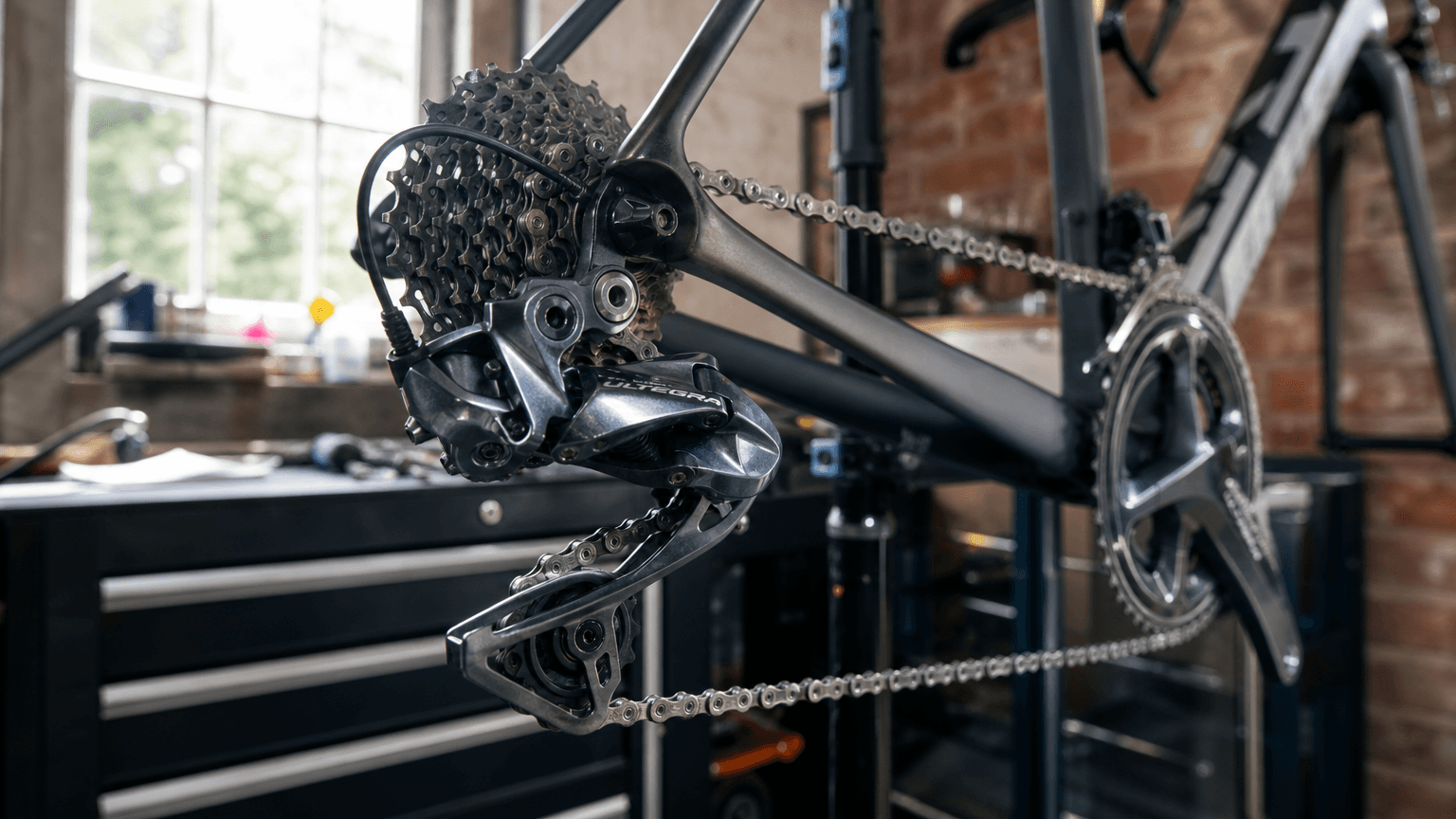
Ultegra sits above 105 and is often described as the enthusiast-to-performance rider's groupset. The R8100 series is 12-speed across mechanical and Di2 variants. Weight savings over 105 are real but modest. The more noticeable difference is in shift feel: Ultegra Di2 in particular is very smooth, very fast, and delivers multi-shift capability that 105 Di2 also shares in the R7100 generation.
Ultegra makes sense if you're doing long sportives, frequent riding in variable conditions, or if you're buying a bike where Ultegra is specified at a discount compared to building up separately.
Shimano Dura-Ace (R9200 series)
Dura-Ace is Shimano's flagship, used by professional road racing teams. The current R9200 series is 12-speed with Di2 as the primary focus; mechanical Dura-Ace exists but is less commonly spec'd on new bikes. Weight is genuinely lower, brake feel and shift speed are at the top of the market, and the price reflects all of that.
For most UK riders, Dura-Ace is a difficult spend to justify unless you're competing seriously or you value having the absolute best components on a long-term keeper bike. The performance gap between Dura-Ace and a well-maintained Ultegra Di2 is something most riders simply won't feel on a club ride or sportive.
SRAM road groupsets: the current line-up
SRAM's road hierarchy runs Rival, Force, and Red. All three tiers now feature eTap AXS wireless electronic shifting as the primary drivetrain option, with mechanical variants available at Rival and Force. SRAM's eTap AXS platform is wireless: there are no shift cables at all, with each derailleur using a rechargeable battery and communicating via the AXS protocol.
SRAM Rival eTap AXS
Rival is SRAM's entry point into the eTap AXS wireless ecosystem, making it one of the cheapest ways to get fully electronic shifting on a road bike. It's 12-speed across the board. Hydraulic disc brakes are standard for Rival eTap AXS; rim brake options are not offered in this version.
The shifting feel is good for the tier and the wireless setup genuinely simplifies cable routing on new builds. Weight is higher than Force or Red, but the day-to-day riding experience of wireless shifting is essentially the same across the SRAM line.
SRAM Force eTap AXS
Force is the mid-level groupset and offers meaningful weight savings over Rival with improved finish quality. It's available in both mechanical and eTap AXS electronic variants. Force eTap AXS is a popular spec on performance bikes in the upper mid-range bracket.
Brake feel with Force hydraulic disc is very good, and the Force crankset uses a more refined interface than Rival. If your budget stretches to Force, the step up is worth it for a bike you plan to ride hard over several seasons.
SRAM Red eTap AXS
Red is SRAM's flagship, and its eTap AXS implementation is the benchmark for wireless electronic shifting. It's significantly lighter than Force, uses carbon fibre components extensively, and the shift speed and tactility are at the top of the road market.
Like Dura-Ace, Red is hard to justify on pure value grounds unless racing performance or ultimate weight savings matter to you. On a well-spec'd complete bike, finding Red at a discount can make the decision more defensible, which is exactly the kind of deal worth monitoring at a platform like Cycling Deals UK.
Mechanical vs electronic shifting: the honest trade-off
Electronic shifting (Shimano Di2 or SRAM eTap AXS) removes cable stretch from the equation entirely. Shifts are indexed by a motor in each derailleur, not cable tension, so the system doesn't degrade the way mechanical shifting does as cables stretch and housing compresses over miles. In practice, this means consistent shifts in wet weather and cold conditions, where mechanical systems can feel sluggish or need more frequent adjustment.
The downsides are real. You're dependent on batteries: Shimano Di2 uses a built-in battery on the rear derailleur or frame-mounted battery depending on generation, and SRAM eTap AXS uses a removable battery on each derailleur. You need to build charging into your routine. If a battery fails mid-ride, you lose shifting. Setup and fault diagnosis are more complex than tensioning a cable.
Mechanical shifting has lower running costs, is simpler to maintain at home or on the road, and a snapped cable or worn housing is a fix most riders can do themselves. For a commuter who rides in all weathers and wants minimal dependency on technology, a well-maintained mechanical groupset is often the right call.
The practical guide: if you ride frequently in UK winter conditions and value consistent performance above all else, electronic shifting is worth the premium. If you prefer maintaining your own bike, want lower long-term running costs, or this is your first serious road bike, mechanical is the more sensible default.
11 vs 12 speed: does the number actually matter?
Speed count refers to the number of sprockets on the cassette. More sprockets mean smaller steps between gears, which translates to finer cadence control and smoother transitions between ratios. The cassette, chain, and derailleur are all matched to that speed count and are not interchangeable between 11 and 12 speed systems.
In use, the difference between 11 and 12 speed is subtle for most riders. What matters more is the cassette range: a 12-speed cassette might offer an 11-34t range that gives you a wider overall spread with small steps throughout, while an 11-speed cassette at 11-28t gives you tighter ratios but less range at the top end. The gearing range is what determines whether you can comfortably climb a long Alpine col or spin out on a flat descent.
The practical point: choose 11 vs 12 speed based on the cassette range available for your riding terrain and the bike you're buying, not based on the higher number being inherently better. Part availability for 11-speed Shimano and SRAM is still strong across UK retailers, so older-platform bikes remain very serviceable.
1x vs 2x: when a single chainring works on a road bike
The vast majority of road bikes use a 2x drivetrain: two chainrings at the front paired with a rear cassette. This gives close gear spacing across a wide total range, which suits the varied gradients of UK road riding.
A single chainring (1x) setup removes the front derailleur entirely, simplifying the drivetrain and saving some weight. It's more common on gravel bikes, but some endurance road bikes and adventure bikes use it. The trade-off is larger jumps between gears, which some riders find jarring on sustained efforts where cadence control matters.
1x works well if your typical rides are hilly enough that you'd use the full range of a wide-range cassette, or if simplicity and lower maintenance are priorities. It doesn't suit riders who need the fine gradations of a 2x system across flat or undulating terrain at high speed.
Chainline and rear derailleur capacity are the compatibility factors that determine whether 1x is viable on a given frame. Not all road frames have the clearance for a wide-range 1x cassette, and the rear derailleur must have enough cage length to handle the full cassette range. Check the manufacturer's specifications before converting.
Best groupset by budget band (UK buyers)
These bands are based on complete bike pricing as a reference point, since groupset-only pricing varies widely by retailer and deal availability. Always check current pricing directly.
Entry-level complete bikes: At this level, you're typically looking at Shimano Claris (8-speed) or Sora (9-speed) on budget road bikes, or Tiagra (10-speed) on slightly better-specified options. These aren't part of the 105/Ultegra/Dura-Ace or SRAM Rival/Force/Red conversation, but they shift reliably and service parts are widely available. If the bike otherwise fits well and the frame is good quality, don't dismiss it on groupset alone.
Mid-range complete bikes: This is where Shimano 105 becomes the standard. Mechanical 105 (R7000 11-speed or R7100 12-speed depending on bike model year) is the default spec at this level, and it's a genuinely excellent drivetrain. SRAM Rival eTap AXS also appears at this price point on some bikes, which gives you wireless electronic shifting at a competitive price. Both are strong choices; the deciding factor is whether you want mechanical simplicity or electronic consistency.
Upper mid-range complete bikes: Shimano Ultegra (mechanical or Di2) and SRAM Force eTap AXS are typical here. Di2 Ultegra at a discounted price is one of the best value propositions in UK road cycling. Serviceability is excellent at this tier: most UK workshops stock Ultegra parts and have Di2 diagnostic tools.
Performance and flagship bikes: Shimano Dura-Ace Di2 and SRAM Red eTap AXS. These are justifiable if you're racing or if the complete bike represents long-term investment in a frame you plan to keep and upgrade. Watch for end-of-season discounts: finding Dura-Ace or Red spec'd on a last-year's bike at a meaningful saving is where monitoring platforms like Cycling Deals UK pays off. The site is updated daily and shows the original price, sale price, and percentage saving clearly, so you can see at a glance whether a 'deal' on a flagship-spec bike is actually a deal.
A note on serviceability: Shimano's parts and service ecosystem is broader across UK independent shops than SRAM's. If you're not near a specialist workshop with SRAM eTap AXS diagnostic tools, factor that in. Mechanical Shimano remains the easiest UK road drivetrain to service, with cables, housing, and derailleurs available at most bike shops.
Best groupset for beginners: resist the upgrade pressure
The honest answer for beginner road cyclists is Shimano 105, mechanical. It shifts precisely enough that you'll never feel held back, it brakes confidently in wet conditions (disc variant especially), and it's easy to maintain or have serviced affordably at any UK bike shop.
Spending more on Ultegra or Di2 makes sense for a beginner only if the complete bike represents strong long-term value (a high-quality frame with a discounted Ultegra spec, for example) or if you're confident the bike is the right fit and you won't be upgrading the frame in two years.
Expensive is not better if it forces you into a narrow cassette range you're not fit enough to ride comfortably yet, or if maintaining the groupset requires tools and knowledge you don't have. A beginner on well-maintained 105 will ride faster and more confidently than a beginner on neglected Dura-Ace.
Before buying any second-hand bike or accepting a floor model at a shop, run through this basic check: click through all gears and verify the shifts are clean and positive, squeeze the brakes and check for consistent modulation, look at derailleur alignment from behind the bike (both derailleurs should be parallel to the cassette/chainrings), and check chain and cassette wear with a chain checker tool if possible.
What matters more than the groupset
Groupset is one variable. On most rides, these factors will affect your experience more:
Frame fit. A bike that fits well lets you maintain cadence and power for longer. A bad fit causes injury regardless of what groupset it carries.
Wheel quality. Wheels affect rolling resistance, handling, and comfort far more noticeably than the difference between 105 and Ultegra. A good set of wheels on a 105-spec bike will often feel faster than cheap wheels on an Ultegra-spec bike.
Tyre choice. Rolling resistance, puncture protection, and wet-weather grip are all tyre variables. Upgrading from a basic training tyre to a quality GP5000 or similar does more for ride feel than most groupset steps.
Brake type. Hydraulic disc braking is a meaningful improvement over rim braking in UK winter conditions. If you're choosing between a rim-brake Ultegra bike and a disc-brake 105 bike at the same price, the disc brakes are likely the better long-term choice for year-round riding.
Maintenance. A clean, well-lubricated mechanical 105 groupset shifts better than a dirty, poorly-adjusted Ultegra. Regular cleaning and cable replacement will do more for shifting quality than upgrading tiers.
FAQ
Can I mix Shimano and SRAM components on the same bike? Generally, no. Shimano and SRAM use different shift indexing logic (cable pull ratios and electronic protocols), so mixing shifters with derailleurs from the other brand produces unreliable shifting. There are third-party adapters that claim cross-compatibility in some configurations, but these are workarounds rather than supported setups. Stick to one brand's groupset unless you've verified compatibility explicitly.
Is Di2 or eTap AXS worth it if I ride casually? Probably not on pure performance grounds. Where electronic shifting makes a casual rider's life easier is in wet weather consistency and in reducing the need for periodic cable adjustments. If you ride year-round in UK conditions and want a bike that shifts reliably with minimal fiddling, it's a legitimate quality-of-life upgrade. If you ride only in good weather, mechanical is simpler and cheaper.
Will I feel the difference between Ultegra and Dura-Ace? In a controlled test, yes: Dura-Ace Di2 shifts faster and the components feel more refined. On a typical UK sportive or club ride, most riders won't feel a meaningful performance gap. The weight difference (roughly 200-300g across a full groupset) is real but marginal compared to the rider's own weight and aerodynamics. Ultegra Di2 is excellent by any practical measure.
What matters more: 11 vs 12 speed, or the cassette range? Cassette range, by some distance. Whether your cassette tops out at a 28t, 30t, or 34t sprocket changes how you climb hills. Whether it's 11 or 12 speed changes the size of the jumps between gears. Both matter, but most riders notice cassette range more directly on real climbs.
How do I know if a bike's groupset is mechanical or electronic at a glance? Look at the rear derailleur: Di2 and eTap AXS derailleurs have a visible battery or motor housing and wiring ports (Di2) or a protruding battery pod (eTap AXS). Mechanical derailleurs have a barrel adjuster for cable tension and a cable clamp bolt. On the shifters, Di2 typically has a smooth lever with a small satellite button or smooth action, while eTap AXS shifters have a visible button-based mechanism rather than a lever that actuates cable pull.
How long will a groupset last, and what wears first? A chain is the first component to wear and should be checked every 1,500-2,000 miles depending on riding conditions. Replacing chains before they're worn significantly extends cassette and chainring life. A cassette typically lasts through two to three chains. Derailleurs, shifters, and calipers can last many years if maintained; cables and housing should be replaced annually on a regularly-used mechanical setup. Electronic components are durable but batteries degrade over time and motor units can eventually require replacement.
Compare live groupset deals before you buy
Once you know which tier and drivetrain type suits your riding, the next step is finding current UK pricing. Groupset prices shift significantly across seasons, as retailers clear prior-year stock and run end-of-season promotions.
Cycling Deals UK is updated daily and aggregates hand-checked deals from UK specialist retailers. Each listing shows the sale price, original price, and percentage saving clearly, so you can judge at a glance whether a promoted price is genuinely good value. The site covers complete bikes, framesets, and components, and many listings include available sizes and direct links to the retailer's product page.
If you're looking for a Shimano 105 road bike, it's worth checking what's on deal before committing to full retail. The same applies if you're comparing Ultegra and Force specs across bikes at a similar price point. Browsing the road bike deals section regularly is the most efficient way to catch meaningful discounts from multiple UK retailers in one place, rather than checking each shop individually.
Your groupset decision: five steps
Work through these in order and the answer becomes straightforward:
- Check your frame's braking standard (disc or rim) and confirm which groupsets are compatible with your specific dropout and derailleur hanger.
- Decide mechanical or electronic based on your maintenance habits and riding conditions.
- Choose 2x or 1x based on your terrain and whether your frame supports the cassette range a 1x setup requires.
- Pick 11 or 12 speed based on the cassette range available for your riding needs and whether the bike you're buying is a current-platform model.
- Map your budget to the appropriate tier: 105 or Rival for excellent performance at mid-range spend, Ultegra or Force for a meaningful step up, Dura-Ace or Red if you're building a long-term race or performance bike and the deal justifies it.
The best groupset isn't the most expensive one or the one with the highest speed count. It's the one that matches how you ride, how you maintain your bike, and what you can actually spend. Check Cycling Deals UK for current UK pricing before you commit.