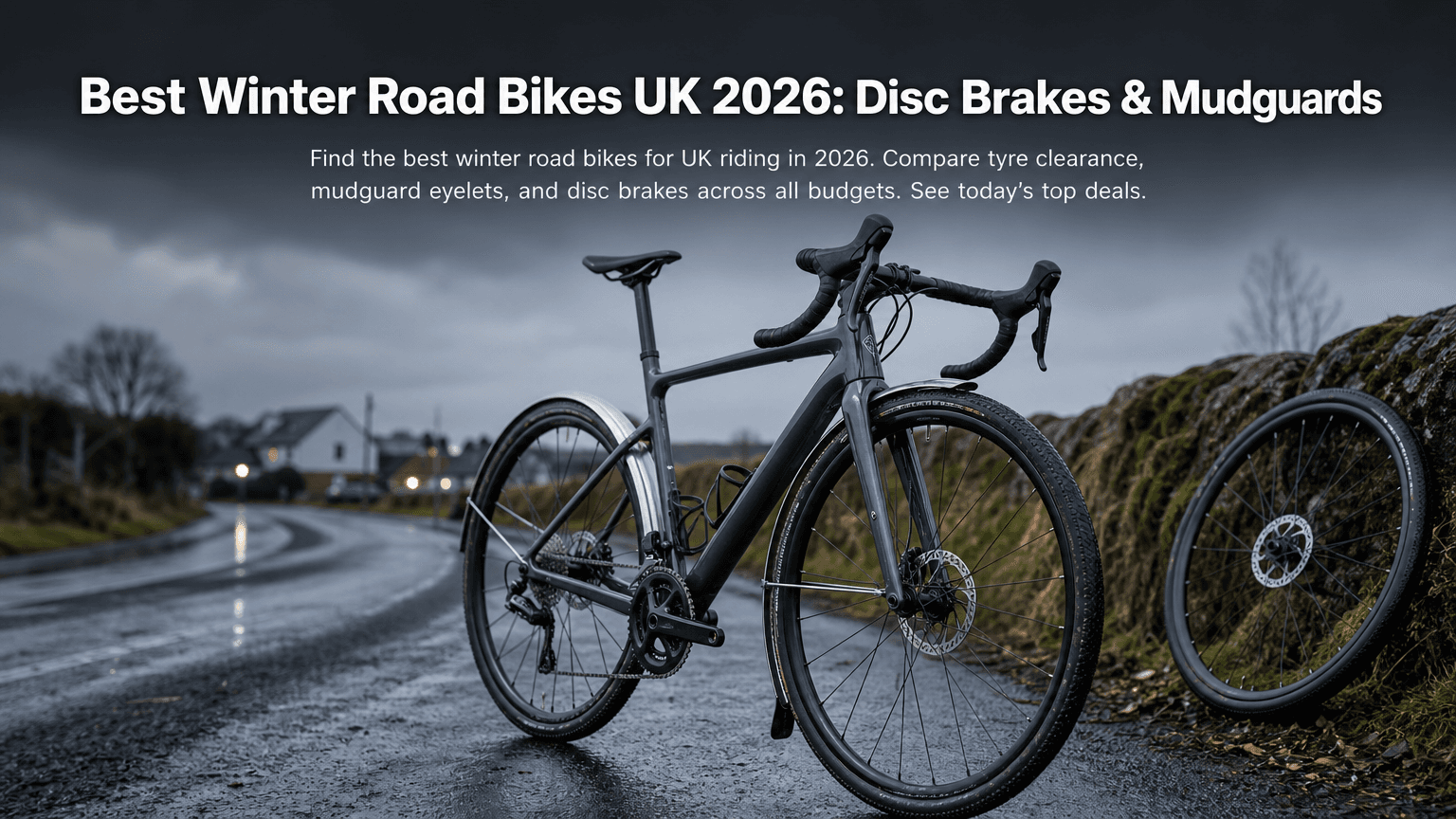
The three winter-ready essentials: tyres, mudguards, and disc brakes
Tyre clearance: the number that drives every other decision
Frame and fork clearance tells you which tyres you can actually fit, and with which guards. BikeRadar reported in November 2024 that winter road bikes typically need clearance "in the region of 32mm–36mm+" to offer realistic winter tyre options, and noted that a frame like the Forme Monyash 2 "has clearance to fit mudguards and still take 32mm tyres." That's the benchmark to use when evaluating any winter road candidate.
The problem with headline clearance figures is that they're usually stated without mudguards fitted. Add a full-length guard and you lose 8–12mm of effective clearance instantly. A frame that claims to accept a 35mm tyre may only accept a 28mm tyre once a guard is in place. Always confirm the manufacturer's stated clearance with mudguards as a separate figure.
As noted by Cycling Weekly, the practical sweet spot for a UK winter road setup is "disc brake ready, with clearance for tyres up to 34c or 30c with room for mudguards/fenders." That gives you two usable configurations: 30mm plus guards for paved-road winter riding, or up to 34mm for rougher or greasy routes where extra volume helps.
Mudguards: full-length, eyelet-mounted, or it doesn't count
Clip-on mudguards exist. They're a compromise at best on a winter bike. Full-length bolt-on guards fitted to proper braze-on eyelets stay put, cover the full tyre arc, and direct spray away from drivetrain and rider. As the Edinburgh Bicycle Cooperative's mudguard guide (October 2024) points out, tyre widths vary significantly between bikes, and getting guard width matched to tyre width is only possible once you know exactly what your frame accepts.
Merlin Cycles advises winter bike buyers to check specifically for "provision for mudguards" before anything else. That means:
- Rear triangle eyelets (chainstay and seatstay)
- Fork crown eyelet or mid-blade mounts
- Enough clearance between tyre and crown to admit a guard without jamming
If a frame has no eyelets, clip-ons are your only option. They'll do the job in a pinch, but they flex, rattle, and frequently contact the tyre under load. For dedicated winter riding, proper eyelets aren't optional.
Disc brakes: consistent stopping, not just in theory
The disc-versus-rim debate still rumbles on, but for UK winters it isn't really a debate. Rim brakes on wet carbon rims are dangerous; even alloy rim brakes suffer measurable performance degradation once wet grit gets onto the braking surface. Hydraulic disc brakes deliver the same lever force-to-stopping-power ratio whether the wheel is dry, wet, or caked in salt. For winter commuting, long training miles in poor weather, or any ride where stopping distances matter, disc brakes are the right call.
Tyre clearance targets: 30mm vs 35mm with full mudguards
The Cycling UK forum (October 2024) confirms that riders commonly run 35mm and even 38mm tyres with mudguards when clearance allows. Here's how to think about the two common configurations:
30mm tyre with full mudguards: Works on most winter-spec endurance road frames with stated clearance of 38mm+. Good for primarily paved riding, gives reasonable puncture protection, compatible with the majority of full-length guards. This is the minimum sensible winter setup.
35mm tyre with full mudguards: Needs a frame with at least 45–47mm stated clearance. Noticeably more comfortable on rough or debris-strewn roads, better at absorbing the vibration of cold-stiffer tyres, and retains traction when tarmac is greasy. Some endurance road frames and most all-road/adventure road builds will accommodate this.
A practical clearance check before buying:
- Find the frame's stated tyre clearance from the manufacturer (not a retailer's description)
- Subtract 10mm for guard clearance as a conservative working figure
- Confirm the resulting number is at or above your target tyre width
- Check at the fork crown and at the chainstay bridge independently, both points may have different limits
UK roads leave grit between tyre and guard. A 3–4mm buffer beyond your tyre width, on each side, prevents jamming during riding.
Comparison matrix: mudguard + clearance + disc brakes at a glance
The table below covers commonly available winter road builds and their key winter-spec figures. Stated clearances are from manufacturer or retailer specs; guard-plus-tyre pairings are estimates based on those figures.
| Model (approx. budget) | Frame | Brakes | Eyelet mounts | Stated clearance | Guard-ready tyre target | Best for |
|---|
| Forme Monyash 2 (under £1,000) | Aluminium | Mechanical disc | Yes | 32mm with guards | 32mm | Value winter trainer, paved |
| Giant Contend AR 2 (mid-range) | Aluminium | Hydraulic disc | Yes | 35mm+ | 32mm with guards | All-season commuter/trainer |
| Trek Domane AL 4 (mid-range) | Aluminium | Hydraulic disc | Yes | 35mm (claimed) | 30–32mm with guards | Endurance winter miles |
| Specialized Allez Sport E5 Disc (mid-range) | E5 Aluminium | Hydraulic disc | Yes (chainstay) | 32mm (claimed) | 30mm with guards | Paved winter commuting |
| Genesis Croix de Fer 10 (mid) | Cromoly steel | Mechanical disc | Full eyelets | 35mm | 32–35mm with guards | Long miles, rougher roads |
| Ribble Endurance AL e (mid-premium) | Aluminium | Hydraulic disc | Yes | 32mm | 30mm with guards | Efficient winter endurance |
Clearance figures reflect manufacturer/retailer spec at time of writing. Confirm the exact model year figure before purchasing. "Guard-ready tyre target" assumes a standard full-length guard fitted at crown and stays.
BikeRadar's November 2024 guide to best winter road bikes is the most thorough public model-by-model reference currently available if you want further detail on individual builds.
All-season build strategy: one bike for every month
The "second bike for winter" approach has merit, but isn't the only answer. A single all-season road bike with a spare set of wheels, one summer-spec, one winter-spec with wider tyres and guards fitted, gives you the best of both. You swap wheelsets rather than bikes, the frame does duty year-round, and you only maintain one drivetrain.
For this to work, the frame needs to accept your widest intended winter tyre with guards fitted, and you need quick-release or thru-axle compatibility across both wheelsets. Endurance road frames with 35mm+ clearance and full eyelets are the obvious candidates. The best road bikes under £1,500 guide covers several builds that meet this spec.
On drivetrains: winter grit chews through chain, cassette, and jockey wheels faster than dry conditions. Expect to clean the chain every two to three rides in genuine British winter conditions, and replace it more frequently than the summer equivalent. Use a wet lube rated for cold temperatures. Bike maintenance and lubrication deals are worth bookmarking for keeping consumables costs down.
Tubeless tyres have a genuine winter case: sealant plugs small punctures from road grit without requiring a roadside stop, and lower running pressures improve traction on cold or wet tarmac. The trade-off is setup time and the need to top up sealant through winter. Either format works; the tyre model and width matter more than the tube format in most cases.
Winter setup checklist: before the first cold snap
Run through this once a year, ideally in late September before conditions deteriorate:
- Fit full-length mudguards and tension the stays so there's no movement under braking or through full handlebar turns. Check for rubbing at the crown and chainstay bridge with the wheel centred.
- Set tyre pressures 10–15 psi lower than your summer setting for the same tyre width. Cold temperatures reduce pressure further overnight, so check before every winter ride.
- Inspect brake pads. Winter grit accelerates pad wear significantly; replace if less than 2mm of compound remains.
- Degrease the chain and re-lube with a winter-rated wet lube. Dry lube washes off in rain within a few miles.
- Check that all eyelet bolts holding the guards are tight. Vibration loosens them over a season.
- After every ride in salt or standing water: rinse the drivetrain, dry the bike, and re-apply lube to the chain. Salt accelerates corrosion on aluminium and steel frames in and around the bottom bracket shell and chainstays.
Steel frames are worth considering here. Cromoly steel corrodes more slowly than untreated aluminium in salt-heavy conditions, and the ride quality on rough winter tarmac is noticeably more forgiving. Aluminium frames are fine with regular care; just make sure any frame you buy has been properly treated at the cable stops and bottom bracket shell.
Where to find discounted winter road bikes in the UK
Pricing for dedicated winter road bikes in 2026 falls into three rough bands:
- Entry (under £800): Aluminium frame, mechanical disc brakes, eyelet mounts, 32mm clearance. Entirely sufficient for UK winter conditions. Brands to watch include Boardman, Carrera, and own-label builds from larger retailers.
- Mid-range (£800–£1,500): Hydraulic disc, wider clearance (typically 35mm), better finishing kit and often tubeless-ready wheels. This is where most of the value lies in 2026.
- Premium (£1,500–£2,500+): Carbon or high-end cromoly, hydraulic disc with better modulation, clearance for 35mm+ with guards. Endurance geometry, often more compliance-oriented for long winter miles.
Cycling Deals UK aggregates discounted road bikes from UK retailers including Evans Cycles, Tredz, Sigma Sports, Merlin Cycles, and Balfe's Bikes. Every listing shows the sale price, original price, percentage saving, and which retailer holds the stock, you get the full picture without visiting six separate shops.
For entry-level winter trainers, the road bikes under £1,000 listings filter down to exactly the right price band. Mid-range all-season builds with disc brakes and genuine mudguard clearance appear regularly in the road bikes under £1,500 and road bikes under £2,000 categories. The endurance road bike deals page is particularly useful for winter-capable builds with wider clearances and compliance-focused geometry.
Stock moves fast on reduced winter bikes. Always verify size availability and current price at the retailer before committing.
You might also want to check winter cycling clothing deals alongside your bike choice, lights, waterproofs, and thermal gloves are as important as the bike itself on short UK winter days.
FAQ: mudguards, tyre clearance, and disc brakes for winter
Can I run full-length mudguards on a road bike? What tyre width is realistic? Yes, provided the frame has eyelets and sufficient clearance. With a frame offering 40mm+ clearance, running a 30mm tyre with full guards is straightforward. With 45mm+, a 35mm tyre becomes realistic. Confirm the figure from the manufacturer, not just the retailer listing.
Do I need disc brakes for winter UK riding? For consistent stopping on wet, gritty roads, hydraulic disc brakes are the right choice. Mechanical disc brakes are acceptable at entry level. Rim brakes on alloy rims work but deliver meaningfully less power in wet conditions and wear through pads and rim surfaces faster with grit.
What's the minimum tyre clearance I should look for? 38mm stated clearance (without guards) is the minimum to safely run a 28–30mm tyre with full mudguards. 45mm gives you genuine flexibility to run 32–35mm tyres with guards. Anything below 35mm stated clearance is tight with guards and limits your options significantly.
Are clip-on mudguards good enough if my frame lacks eyelets? For occasional wet rides, yes. For a dedicated winter bike, no. Clip-ons flex under load, can contact the tyre at speed, and don't provide full-arc coverage. A frame without eyelets isn't ideal for committed winter road riding.
What tyres work best with winter mudguards? Tyres with a reflective sidewall strip and a puncture-protection belt (Schwalbe Marathon, Continental Grand Prix 4-Season, Vittoria Randonneur) are the standard recommendations. Avoid tyres that run significantly wider than their stated width on your rim width, this reduces effective clearance and increases rub risk with guards fitted.
How often should I clean and lube my winter bike? After every ride in rain, salt, or standing water: rinse, dry, and re-lube the chain. Full drivetrain degreasing every three to five rides in hard winter conditions. Inspect brake pads monthly.
Can I convert my current road bike into a winter bike? Check three things first: stated tyre clearance with mudguards, presence of eyelet mounts, and brake type. If your frame offers 38mm+ clearance with eyelets and hydraulic disc brakes, a winter wheel/tyre/guard setup is entirely viable. If it lacks eyelets or has less than 35mm clearance, a dedicated winter frame is the practical solution rather than a workaround.
Start with the tyre, work backwards to the frame
The most reliable way to approach a winter road bike purchase is to choose the tyre width you want to run with full mudguards, then find a frame that delivers that clearance with guards fitted. Everything else, geometry, material, groupset, is secondary to getting that fundamental spec right.
For 30mm winter tyres with full guards: look for 40mm+ stated clearance, full eyelets, and hydraulic disc brakes. For 35mm tyres with full guards: hold out for 47mm+ clearance and confirm it at both crown and chainstay bridge.
Once you've set those criteria, browse the current road bike deals on Cycling Deals UK and filter by price band. The platform checks UK retailers daily and surfaces genuine reductions with clear savings data, so you're comparing real discounts rather than inflated RRP figures. Check the best road bike deals page for the latest offers across all price points.