Run the 10-point checklist, then compare two live bikes on Cycling Deals UK — the best place to see was/now pricing from UK specialists. Browse road bike deals and cross-check geometry, groupsets and tyre width.
1. The right geometry for your body and your routes
Geometry is how a bike fits your body before you touch the components. The two numbers that matter most are reach (the horizontal distance from bottom bracket to top of the head tube) and stack (the vertical equivalent). A higher stack suits riders who want a more upright, comfortable position. A lower stack with longer reach suits those chasing a more aggressive, aerodynamic position.
Don't assume two bikes labelled "Medium" fit the same. A 56cm from one brand can have a reach 15mm longer than a 56cm from another. Always check the geometry chart, not the size label.
Ask yourself: how flexible are you? How many hours will you spend in the drops? Have you felt stretched or cramped on previous bikes? Your answers tell you which direction to adjust stack and reach, and which bike to shortlist.
Wheelbase is worth a glance too. A longer wheelbase generally means more stability at speed and on rough roads. A shorter one is sharper handling. For most UK riding, stability wins.
2. A frame that earns its price
The frame is the structure everything else hangs off, so it needs to justify the spend. If you're looking at a carbon frame, check whether the spec sheet mentions the layup or carbon grade. Vague phrases like "premium carbon" or "aero carbon frame" without measurable data are filler. Concrete specs (tube profiles, layup details, stiffness ratings) are the real thing.
Look at the build finish around the bottom bracket shell, the seatpost clamp, and the fork crown. These areas take the most load and are where manufacturing quality shows up first. Integrated internal cable routing is a nice feature, but only if it's well executed. Sloppy routing channels can make future servicing a genuine headache.
Two bikes at the same price: the one with a clearly spec'd frame, decent tyre clearance (more on that shortly), and a standard drivetrain mount is usually the better long-term investment.
3. The groupset: more than just a brand name
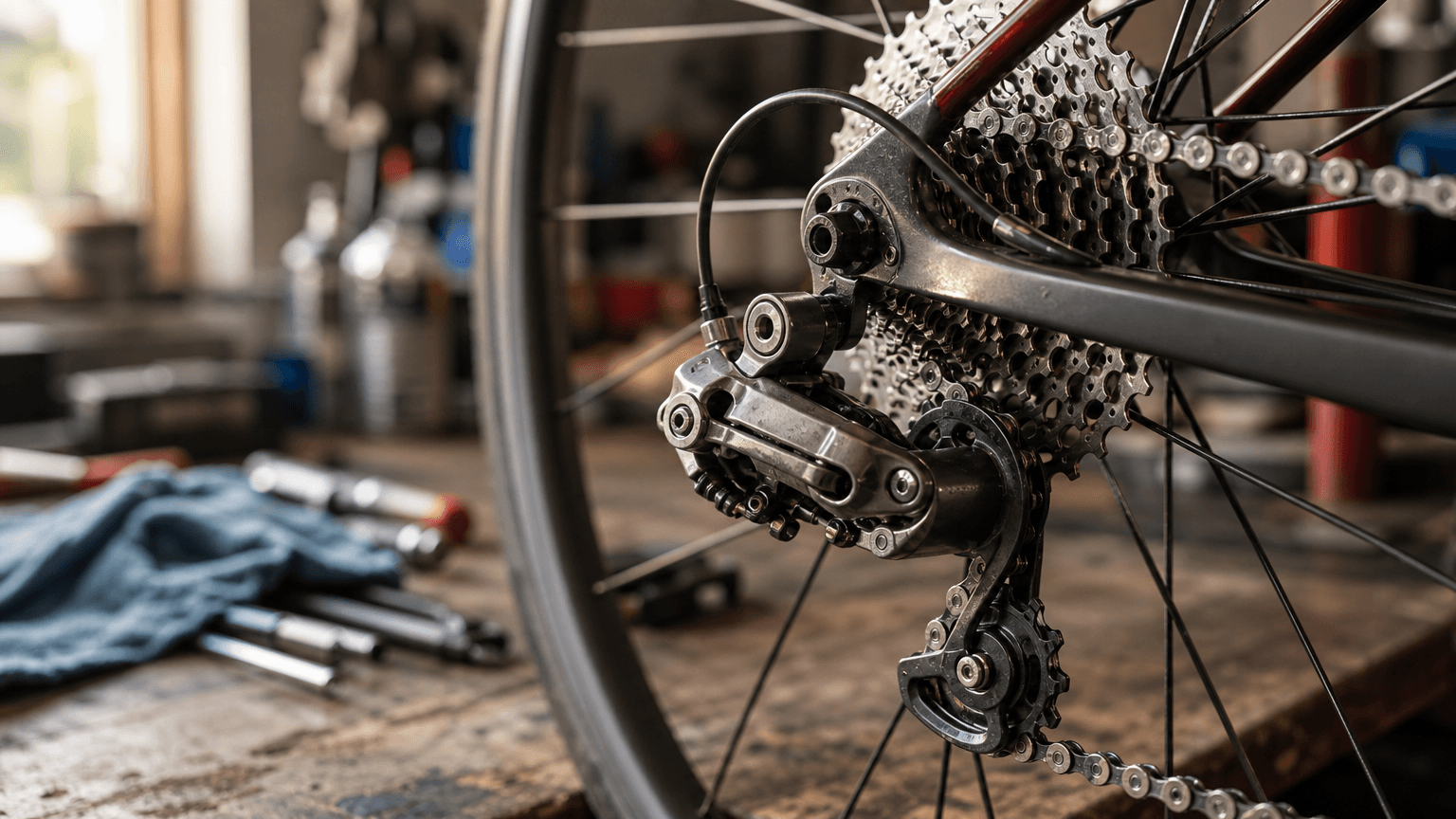
A groupset covers your shifters, derailleurs, brakes (on rim-brake builds), chain, cassette, and chainrings. The brand matters less than the generation and tier. A current mid-tier groupset from Shimano or SRAM will outshift an older top-tier one in most conditions.
The key questions when comparing two bikes on spec sheets:
- Is it a complete, matched groupset or a mix of components from different tiers?
- What generation is the rear derailleur? Older generations can limit cassette range options.
- Are the shifters and derailleur from the same system? Mixing groups across generations causes shifting problems.
- Is it mechanical, electronic, or wireless? Electronic shifting is more consistent but adds cost and a charging routine.
On the 2x vs 1x road gearing question: 2x (two chainrings) gives you a wider overall range and finer steps between gears, which suits most UK road riders. 1x (single chainring) is simpler and lighter but can leave gaps in the middle of the cassette and may feel stretched thin on long climbs unless the cassette range is large enough.
Parts availability in the UK is a practical concern. Widely distributed groupsets (Shimano 105, Ultegra, GRX; SRAM Rival, Force) are easy to service at most UK bike shops. Niche or proprietary drivetrains can mean longer waits and higher parts costs.
4. Tyre clearance you can actually use
The clearance figure on a spec sheet tells you the maximum tyre width the frame and fork can accommodate. What it doesn't always tell you is whether that measurement was taken with the tyre at full inflated width, or just at the carcass, and whether it applies equally at the fork crown, the chainstays, and the seatstays.
A bike claiming 30mm clearance that only achieves it with one specific tyre casing isn't the same as one that runs a genuine 30mm regardless of brand.
Why does it matter for UK riders? Wider tyres (28mm, 30mm, 32mm) roll more comfortably on chip-sealed and poorly maintained roads, offer better grip in the wet, and reduce the frequency of pinch punctures. Most road bikes now clear at least 28mm, but there's a meaningful difference between a bike that clears 28mm with millimetres to spare and one that runs easily to 32mm.
When comparing two bikes, treat the tyre clearance figure as the upper limit, then check independent reviews where testers have measured actual clearance with real tyres. A 2mm margin might not be usable in practice.
5. How to judge the wheels
Wheels are the single upgrade that makes the biggest perceptible difference on a road bike. They affect acceleration, crosswind stability, climbing, and rolling resistance. This makes the stock wheelset a genuinely important spec item, not an afterthought.
What to look at:
- Rim depth: Shallower rims (under 35mm) are lighter and more stable in crosswinds. Deeper rims (40mm+) have aerodynamic advantages on flat roads but catch wind on exposed routes.
- Hub quality: The number of engagement points (or degrees of engagement) affects how quickly power transfers when you resume pedalling. Lower-quality hubs have more free-spin before engagement.
- Tyre compatibility: Check whether the rims are hookless (tubeless-ready) or hooked. This affects which tyres and pressures you can safely run.
- Serviceability: Can you replace the bearings yourself, or does the hub design require proprietary tools?
At mid-range price points, stock wheels are often the area where manufacturers cut costs. If the wheelset is a no-name or unbranded option, expect to replace it sooner. Factor that into your value comparison.
6. Brakes: disc vs rim for UK roads
The debate between disc brakes and rim brakes on road bikes is largely settled for new builds. Disc brakes offer more consistent stopping in wet conditions, better modulation, and the freedom to run wider tyres without worrying about the brake track. For UK riding in autumn and winter, the wet-weather performance advantage is real.
Rim brakes are lighter, simpler, and still perfectly adequate in dry conditions. Some riders prefer them for the direct feel and the ease of roadside repairs.
If you're evaluating a disc-brake bike, check:
- Rotor size: 140mm rotors are standard and adequate for most road use. 160mm rotors offer more stopping power and better heat dissipation on long descents.
- Pad and rotor standard: Most road disc bikes use flat-mount calipers. Check that the wheelset's rotor interface (6-bolt or Centre Lock) matches the calipers, or that adapters are included.
- Caliper brand and model: Named caliper brands on the spec sheet indicate known quality. Generic "hydraulic disc" without a named component is a warning sign.
For rim-brake bikes, check the rim material and braking surface compound. Aluminium rims with a machined braking track stop well. Carbon rims need specific brake pads (usually resin) and can overheat on long descents if the wrong pads are used.
7. Gear range that matches your actual hills
Two bikes can both be labelled "2x11" and have completely different climbing capability. The chainring sizes and cassette range together determine your lowest gear.
A compact crankset (50/34 chainring) paired with an 11-32 cassette gives a very different lowest gear ratio from a standard crankset (53/39) with an 11-28 cassette. The first combination is far more forgiving on steep UK climbs.
The practical check: find the lowest gear combination (smallest chainring + largest cassette sprocket) and ask whether you could turn that gear comfortably on the steepest climb on your usual routes. If you're unsure, gear calculators are freely available online and take about two minutes to use.
Gear spacing (the jump between each cog) matters on longer rides. A wide-range cassette with large jumps can make it harder to maintain a smooth cadence. If you're comparing two bikes with similar overall range, the one with smaller steps in the middle of the cassette will feel smoother on sustained climbs.
8. Fit: the spec sheet details most buyers ignore
A bike with excellent components fitted to the wrong geometry for your body will be uncomfortable and, over time, cause injury. Fit is non-negotiable.
Beyond reach and stack (covered in point 1), the spec sheet often lists:
- Stem length: A shorter stem (70-80mm) is more manoeuvrable and suits riders who want a more upright position. A longer stem (110mm+) suits riders comfortable stretching forward.
- Handlebar width: Measured centre-to-centre. Ideally this matches your shoulder width. Too wide increases drag; too narrow restricts breathing.
- Seat tube angle: A steeper seat tube angle (74°+) moves your hips forward over the pedals, which suits a more aggressive riding style. Slacker angles are common on endurance builds.
If you're between sizes, the spec sheet comparison becomes critical. Go up a size and you typically get more reach and a higher stack. Go down and you get a more compact cockpit. Neither is inherently wrong; it depends on your flexibility and riding style.
Stack is particularly useful for spacer management. A frame with lower stack requires more headset spacers to achieve a comfortable bar height, which is fine in the short term but limits how low you can go later if you want a more aggressive position.
9. Upgrade potential: where a bike can go over time
The best-value road bike isn't always the one with the best components out of the box. It's the one where your budget goes furthest over the next two or three years.
Identify the upgrade bottlenecks before you buy:
- Tyres are the cheapest and most impactful upgrade. If the bike ships with budget tyres, factor in replacement cost. This is almost always worth doing early.
- Wheels are the next highest-impact upgrade. Check that the frame's axle standard (thru-axle or quick release) and spacing match widely available wheelsets.
- Bottom bracket standard: Threaded BBs (BSA, T47) are easier and cheaper to service than press-fit. If the spec sheet lists a threaded BB, that's a point in the bike's favour.
- Groupset upgrades: Electronic groupsets can sometimes be added to frames designed for mechanical systems, but not always. Check brake caliper mount compatibility before assuming you can upgrade later.
A bike with standard axle spacing, a threaded BB, flat-mount disc calipers, and a widely distributed groupset gives you the most flexibility for future upgrades using parts you can buy from any UK bike shop.
10. Overall value: how to compare two road bikes properly
Once you've worked through the first nine points, you have a genuinely useful picture of both bikes. Now you can compare them fairly.
Build a quick mental scorecard:
- Geometry suitability for your body and riding style
- Frame quality relative to price
- Groupset completeness and serviceability
- Tyre clearance practicality
- Wheel quality and replaceability
- Brake type and rotor/caliper spec
- Gear range for your routes
- Fit match (stem, bars, seat angle)
- Upgrade path and standards compatibility
The bike that scores well across most of these points is the better buy, even if its spec sheet is less impressive at a glance. Vague marketing language ("ultra-responsive", "race-tuned geometry", "lightweight carbon") adds nothing to the scorecard. Concrete model numbers, measured clearances, and named components do.
Once you've applied the checklist, use Cycling Deals UK to compare live prices on road bikes from UK retailers. The platform aggregates hand-checked deals with clear sale prices, original prices, and percentage savings so you can see exactly what you're getting for your money across multiple shops without having to tab through each one individually.
Your 10-point checklist in practice
The spec sheet is a map. It tells you where the bike will take you if you know how to read it. Work through geometry and fit first (points 1 and 8) because no groupset upgrade fixes a bike that doesn't suit your body. Then check the frame's practical specs (points 2 and 4), the drivetrain (points 3 and 7), the stopping and rolling equipment (points 5 and 6), and finally the upgrade path (point 9).
Run this checklist on every bike you're considering and the decision usually becomes straightforward. The bike with fewer compromises across these 10 areas wins, regardless of what the marketing copy says.
After you've done the work, Cycling Deals UK's road bike deals is the fastest way to check whether the bike you've shortlisted is currently discounted at a UK retailer, what size is in stock, and how much you'd save compared to the standard retail price. It's the last step that turns good spec-reading into a good deal.